How to Build Your Down Payment Funding Stack: 4 Sources to Unlock Your First Home
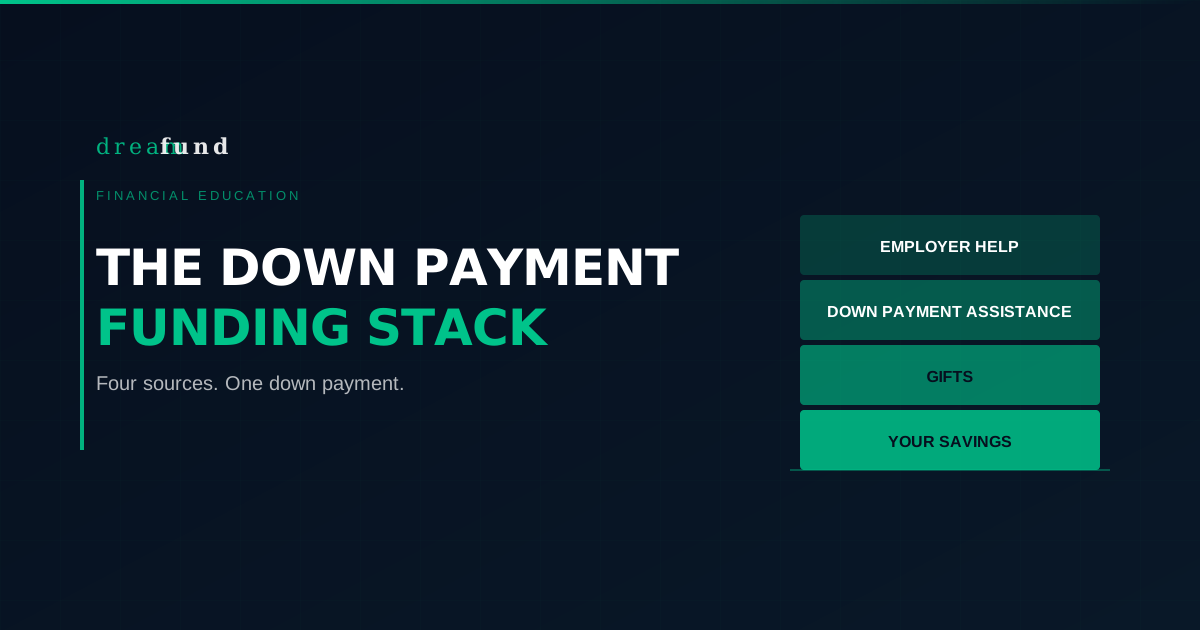
A down payment funding stack combines four sources toward one down payment: your own savings (and a co-buyer's), gifts from family and friends, down payment assistance (DPA) programs, and employer help. Each source has its own rules, and your lender decides which combination it will accept.
Saving a down payment alone is hard. NAR's 2025 Profile of Home Buyers and Sellers put the median first-time buyer down payment at 10%, matching the highest level recorded since 1989. A funding stack spreads that job across more than one source, so personal savings are not the only lever.
What is a down payment funding stack?
A down payment funding stack is the practice of combining several sources toward one down payment instead of relying on a single lump sum of savings. The name borrows from the capital stack in commercial real estate, where a project is financed by layering different funding sources. For a home, the layers are the four sources below.
A stack can reduce how much you have to save on your own, but no source is guaranteed and no timeline applies to everyone. What works depends on your savings, the programs available where you live, and what your lender accepts.
Many buyers also assume they need 20% down. The median first-time buyer put down 10% (NAR, 2025). Your required amount depends on your loan program, so ask your lender, and see how much down payment you need in 2026.
| Source | What it is | Ask first |
|---|---|---|
| Buyer and co-buyer funds | Savings and other assets that you and a co-buyer own | Where each dollar came from, and what your lender needs to verify it |
| Gifts from family and friends | Money given with no expectation of repayment | Whether your lender accepts the donor and what documentation it requires |
| Down payment assistance | Grants, forgivable or deferred second loans, and matched savings from state, local, lender and Federal Home Loan Bank programs | Eligibility, whether funds are available, and repayment terms |
| Employer help | A housing benefit from an employer, where one exists | Whether the employer has an established program and how funds are paid |
Source 1: How do buyer and co-buyer funds work?
Your own funds, and a co-buyer's, are the foundation of the stack. Personal savings were the most common source of a first-time buyer's down payment, used by 59% of first-time buyers, and another 26% used financial assets such as a 401(k), stocks or cryptocurrency (NAR, 2025 Profile of Home Buyers and Sellers, released November 4, 2025). Whatever the source, your lender will ask where the money came from, so keep statements and records of every transfer.
If you are thinking about retirement money, read the rules first. The IRS describes two common routes, and your plan decides whether it offers either one:
- A plan loan. The limit is the lesser of 50% of your vested account balance or $50,000. A plan loan generally must be repaid within five years, with an exception to the five-year rule when the loan is used to buy a primary residence. If you leave your employer, the plan may require you to repay the balance, and an unpaid amount can be reported as a taxable distribution (IRS, Retirement topics: Loans, last reviewed February 26, 2026).
- A hardship distribution. Costs directly related to buying your principal residence (excluding mortgage payments) are a listed hardship reason. A hardship distribution is taxable income unless it consists of Roth contributions, may carry a 10% additional tax on early distributions, and cannot be repaid to the plan (IRS, Retirement topics: Hardship distributions, last reviewed February 26, 2026).
Talk with your plan administrator and a tax advisor before you rely on retirement funds, because taking money out can cost you tax and long-term savings.
Source 2: How do gifts from family and friends fit in?
Gifts are a common source: 22% of first-time buyers used a gift or loan from family or friends toward their down payment (NAR, 2025 Profile of Home Buyers and Sellers). Lenders require documentation, and the lender decides what it accepts.
For conventional loans, Fannie Mae's Selling Guide says gift funds may fund "all or part of the down payment, closing costs, or financial reserves." The gift must be evidenced by a letter signed by the donor that states the dollar amount of the gift, that no repayment is expected, and the donor's name, address, telephone number and relationship to the borrower. The donor cannot be affiliated with the builder, the developer, the real estate agent or any other interested party (Fannie Mae Selling Guide B3-4.3-04, topic dated February 4, 2026). Other loan programs and individual lenders can add their own rules.
Ask before you collect. The Selling Guide lists relatives and says certain non-relatives who share a familial relationship with the borrower may qualify. Contributions from people outside those groups may not be accepted, so ask your lender who counts as an acceptable donor before anyone sends money. Tax rules for gifts apply to the giver, so givers can ask a tax advisor about their own situation.
Dreamfund has not launched yet and is building a way for family and friends to give toward a buyer's down payment goal, like a registry for the milestone that matters. Each gift is recorded with who gave it, their relationship to the buyer, and a signed no-repayment attestation. The buyer's lender decides what gift documentation it accepts.
For the details, read what a gift letter for a mortgage must say, our down payment gift guide and how to ask family for down payment help.
Source 3: What is down payment assistance, and who qualifies?
Down payment assistance (DPA) is any program that helps cover the upfront cash for a home purchase. It usually comes in one of these forms:
- Grants. Money you receive toward the purchase, often with conditions such as a required period of living in the home.
- Forgivable second mortgages. A second loan that is forgiven over time if you meet the program's conditions.
- Deferred-payment loans. A second loan that comes due later, often when you sell or refinance.
- Matched savings programs. Programs that add to money you save yourself.
Many buyers may be eligible and do not know it. An Urban Institute analysis found that 43.6% of 2022 homebuyers in the 10 largest U.S. metro areas were potentially eligible for DPA, and the Urban Institute notes that many new homebuyers do not know they may be eligible (Urban Institute, Urban Wire, December 7, 2023). "Potentially eligible" means a buyer appeared to meet program rules in the data. It does not mean the buyer was approved.
You also do not necessarily need a low income. Down Payment Resource's Q2 2026 index counted 2,746 programs nationwide as of July 1, 2026. Of those, 62% serve incomes above $100,000, and 11% (291 programs) carry no income restrictions. Only 77% were active and funded, so confirm that a program still has money before you plan around it (Down Payment Resource, published July 22, 2026).
Programs differ in income limits, price caps, location and repayment terms, and many are reached only through participating lenders. A HUD-approved housing counselor can tell you which programs are worth pursuing where you live. Dreamfund does not provide down payment assistance grants. Start with these guides:
- First-time homebuyer down payment assistance
- State programs in NJ, NY, CA, TX, FL and PA
- Why higher-earning buyers still use assistance
- HUD housing counseling
Source 4: What is employer down payment assistance?
Employer down payment assistance is help with your down payment or closing costs from your employer. Fannie Mae's Selling Guide says that for a principal residence a borrower "may use funds provided by an employer to fund all or part of the down payment or closing costs." The funds must come from an established company program, not an accommodation made for one employee, and they must come directly from the employer, including through an employer-affiliated credit union. The lender documents the dollar amount (Fannie Mae Selling Guide B3-4.3-08, read October 15, 2026).
Think of it as the housing version of an employer match, with one difference: it only exists if your employer offers it. Ask HR whether a housing benefit is available, and read our guide to employer-assisted housing. Employer contributions are not currently supported on Dreamfund.
How do you put the four sources in order?
Work outward from your lender, then fill each layer you can use. These steps keep the search efficient:
- Start with a lender or HUD-approved housing counselor. Ask which loan program fits you and which combinations of gifts, assistance and employer help it accepts.
- Check assistance where you live. Look up your state housing finance agency, your county or city housing office, and ask your lender about Federal Home Loan Bank programs.
- Ask HR about a housing benefit. If one exists, find out how it is paid and how it is documented.
- Tell your givers what the lender needs before anyone sends money. That means the gift letter and a record of where the money came from.
- Keep records of every source from day one. Save letters, award documents and transfer records in one place.
The down payment is not the only cash due at closing. Closing costs are a separate bill, so see closing costs explained for first-time buyers and our cash to close guide. For how the sources combine, read down payment stacking in 2026.
What are the figures behind this guide?
| Figure | Value | Source and date |
|---|---|---|
| Median down payment, first-time buyers | 10%, matching the highest level recorded since 1989 | NAR, 2025 Profile of Home Buyers and Sellers, released November 4, 2025 |
| First-time buyers who used personal savings | 59% | NAR, 2025 Profile of Home Buyers and Sellers, released November 4, 2025 |
| First-time buyers who used financial assets such as a 401(k), stocks or cryptocurrency | 26% | NAR, 2025 Profile of Home Buyers and Sellers, released November 4, 2025 |
| First-time buyers who used a gift or loan from family or friends | 22% | NAR, 2025 Profile of Home Buyers and Sellers, released November 4, 2025 |
| 2022 homebuyers in the 10 largest metro areas potentially eligible for DPA | 43.6% | Urban Institute, Urban Wire, December 7, 2023 |
| Homebuyer programs tracked nationwide | 2,746 as of July 1, 2026; 62% serve incomes above $100,000; 291 have no income restrictions; 77% active and funded | Down Payment Resource, Q2 2026 index, published July 22, 2026 |
| Retirement plan loan limit | The lesser of 50% of the vested balance or $50,000 | IRS, Retirement topics: Loans, last reviewed February 26, 2026 |
Frequently asked questions
What is a down payment funding stack?
It means combining more than one source toward a single down payment: your own and a co-buyer's savings, gifts from family and friends, down payment assistance programs, and employer help. Which combinations are allowed depends on your loan program and your lender.
What are the main sources of down payment funds?
The four covered here are buyer and co-buyer funds, gifts from family and friends, down payment assistance programs, and employer help. In NAR's 2025 Profile of Home Buyers and Sellers, 59% of first-time buyers used personal savings, 26% used financial assets such as a 401(k), stocks or cryptocurrency, and 22% used a gift or loan from family or friends.
Can you use a gift and down payment assistance for the same home?
Often, but confirm with your lender and the program administrator. Each source needs its own documentation, such as a signed gift letter for a gift, and programs can set their own rules about combining with other funds.
Can you use your 401(k) for a down payment?
It depends on your plan. The IRS describes plan loans, limited to the lesser of 50% of your vested balance or $50,000, and hardship distributions, which are taxable, may carry a 10% additional tax, and cannot be repaid to the plan. Ask your plan administrator and a tax advisor before you rely on it.
Does Dreamfund provide down payment assistance?
No. Dreamfund does not provide down payment assistance grants, and employer contributions are not currently supported. Dreamfund has not launched yet and is building a way for family and friends to give toward a buyer's down payment goal.
Sources
- NAR, 2025 first-time buyer press release
- Urban Institute, Expanding Down Payment Assistance Awareness Could Help More People Afford a Home
- Down Payment Resource, Q2 2026 program index
- Fannie Mae Selling Guide B3-4.3-04, personal gifts
- Fannie Mae Selling Guide B3-4.3-08, employer assistance
- IRS, Retirement topics: Loans
- IRS, Retirement topics: Hardship distributions
Start with your people.
Dreamfund is building a way for family and friends to give toward your down payment goal. Join the waitlist to hear when it opens.
Join the waitlistImportant Notice: Dreamfund is not a bank and does not hold customer funds. Upon launch, each customer's savings will be held in a deposit account opened in the customer's own name at an FDIC-member institution. FDIC deposit insurance applies to deposits at the member bank subject to applicable limits. Dreamfund itself is not FDIC-insured and does not guarantee any savings outcome.
This article is for informational purposes only and does not constitute financial, mortgage, tax, or legal advice. Down payment assistance program availability, eligibility, and terms vary by program, lender, and state, and are subject to change. Mortgage underwriting standards vary by lender and loan program. Consult a HUD-approved housing counselor, a licensed mortgage professional, or a qualified tax advisor for guidance specific to your situation.