How to Give the Perfect Down Payment Gift
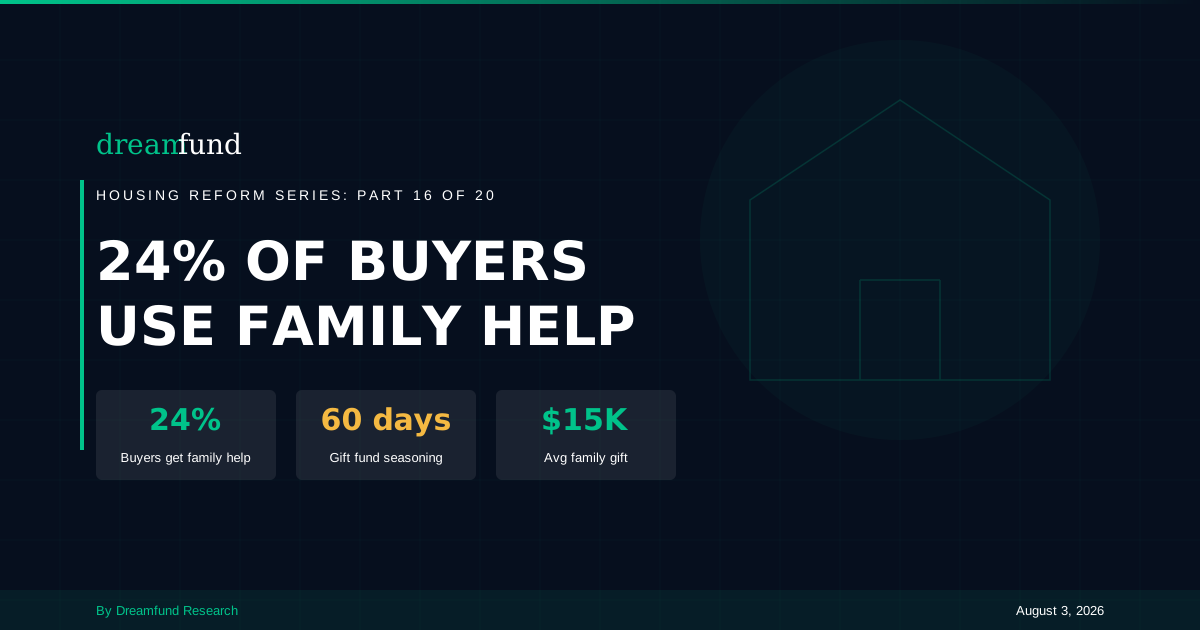
Everything you need to know about giving a down payment gift: mortgage rules, documentation requirements, gift letters, and how to make your support actually count at closing.
Someone in your life is saving for their first home. And you want to help.
Maybe it is your child. A sibling. A close friend who has been renting for a decade and is finally close to making the jump. Whatever the relationship, the feeling is the same: you have money you are willing to give, and you want it to actually make a difference.
The good news is that down payment gifts are one of the most powerful forms of financial support you can provide. The even better news is that the mortgage system is built to accept them, as long as they are documented correctly.
Here is what you need to know before you write the check.
Mortgage Programs Already Accept Gift Funds
Every major mortgage program in the United States allows down payment gifts from eligible donors. FHA loans allow the entire down payment to come from gifts, with no minimum required from the buyer's own savings. Conventional loans accept gifts with documentation. VA and USDA loans also permit community contributions.
The rules vary slightly by program and loan-to-value ratio. But the principle is consistent: lenders are comfortable with gift funds because they are not a debt the buyer has to repay, which means they do not affect the buyer's debt-to-income ratio the way a personal loan would.
Documentation Is Everything
This is the part most well-intentioned donors miss.
A gift given informally, as cash, as a check deposited without documentation, or as a wire transfer without a paper trail, creates problems for the buyer's mortgage application. Lenders scrutinize every large deposit on a bank statement. An unexplained deposit can look like an undisclosed loan, which can trigger underwriting delays or, in the worst cases, cause the loan to be denied.
The right way to give a down payment gift:
Step 1: Write a gift letter. This is a signed document stating your name, your relationship to the buyer, the gift amount, and a clear statement that the money is not a loan and does not need to be repaid. Your buyer's lender or loan officer can provide the exact template their program requires.
Step 2: Transfer funds cleanly. Wire the money directly to the buyer's dedicated savings account, or to a platform specifically designed to hold and document homebuyer contributions. Do not give cash. Do not split the gift across multiple small transfers to avoid documentation. Lenders will see this as structuring and it creates more scrutiny, not less.
Step 3: Be ready to show the source. Some programs require the donor to show bank statements proving the funds existed in their account before the transfer. This is normal. It is not an accusation. It is a standard underwriting verification.
Step 4: Coordinate with the buyer early. The worst time to sort out gift documentation is at the closing table. Ask the buyer to loop in their loan officer before you transfer anything. Many issues can be avoided by getting the right template in advance.
Who Can Give a Down Payment Gift?
Most programs accept gifts from:
- Parents and step-parents
- Grandparents
- Siblings and step-siblings
- Aunts and uncles
- Close friends with a documented relationship
- Employers (in some programs)
- Charitable or government organizations
The definition of an eligible donor varies by loan type. FHA has the broadest standards. Conventional loans via Fannie Mae and Freddie Mac have specific relationship documentation requirements. VA and USDA have their own guidelines. Your buyer's loan officer is the right person to confirm what your specific situation requires.
How Much Can You Give?
There is no mortgage-program limit on the gift amount. You can give $500 or $50,000 and the mortgage rules treat the documentation the same way.
There are gift tax rules to be aware of at the federal level. In 2026, the IRS annual gift tax exclusion is $19,000 per recipient. Gifts below this threshold in a calendar year do not require any tax filing. Gifts above this amount require a Form 709 from the donor, but no tax is actually owed unless you have exceeded your lifetime exemption, which is currently $13.61 million per person.
For most down payment gifts, you are well within the annual exclusion and tax is not a consideration.
The Most Meaningful Gift You Can Give
A down payment gift is not a one-time transfer. For a first-time buyer in your life, it is the difference between staying in a rental for another three years and closing on a home this year.
It is the gift that keeps compounding: in equity, in stability, in the intergenerational wealth your support helps build.
If you are ready to help, talk to the buyer first. Find out what they need, how their loan is structured, and what documentation their lender requires. Then give with intention, give with documentation, and give knowing it counts.
Find out how close you actually are
Dreamfund helps buyers and their communities close the down payment gap together. Join the waitlist to be among the first to launch when we open.
Join the waitlistDreamfund is not a bank and does not hold customer funds. Upon launch, each customer's savings will be held in a deposit account opened in the customer's own name at an FDIC-member institution. FDIC deposit insurance applies to deposits at the member bank subject to applicable limits. Dreamfund itself is not FDIC-insured and does not guarantee any savings outcome. This article is for informational purposes only and does not constitute financial, mortgage, or legal advice. Consult a HUD-approved housing counselor or licensed mortgage professional for guidance specific to your situation. Loan program requirements and down payment assistance programs vary by lender, state, and eligibility criteria and are subject to change.