From Renter to Owner: The Real Homebuying Timeline and How to Speed It Up
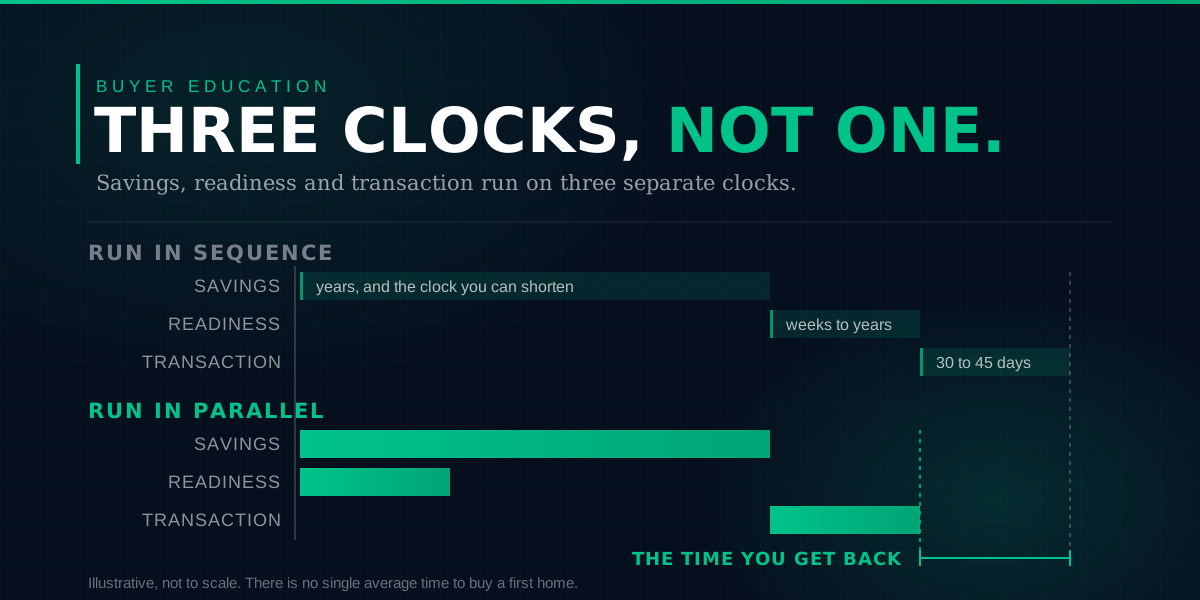
"How long will this take?" is the first question almost every renter asks when they start thinking seriously about buying. The honest answer is that it depends less on the market than most people expect, and more on three things a buyer can actually influence.
Why "it depends" is the real answer
Ask five people how long it took them to buy their first home and you will get five different numbers, because "homebuying timeline" is actually three separate timelines stacked on top of each other:
- The savings timeline: how long it takes to reach a down payment and closing-cost number you are comfortable with.
- The readiness timeline: how long it takes your credit, debt-to-income ratio, and documentation to be mortgage-ready.
- The transaction timeline: the actual shopping, offer, underwriting, and closing process once you start looking.
Most of the "it took forever" stories are about timeline #1. Most of the "it happened so fast" stories are about timeline #3. They are not the same clock, and conflating them is what makes the whole process feel unpredictable.
Timeline #1: Savings, the long pole in the tent
This is where most first-time buyers actually spend most of their time, and it is also the timeline with the most room to compress if you know where to look.
A buyer saving purely out of a paycheck, with no other source, is on a multi-year clock in most markets. That is the default case, and it is exactly why it can feel like homeownership keeps receding the harder you save.
Three things shorten it without changing your income:
- Stacking sources instead of relying on one. A down payment does not have to come from a single savings account. Gift funds from family, employer housing benefits, state and local down payment assistance programs, and community gifting can all be combined, provided each is documented the way your lender requires. Buyers who stack two or three sources typically close faster than buyers waiting to save the entire amount alone.
- Right-sizing the target instead of over-saving. Many first-time loan programs allow down payments well below 20%, with mortgage insurance covering the gap. Saving for 20% when your loan program only requires 3–5% adds years to the clock for a benefit (avoiding mortgage insurance) that may not be worth the delay for a first home you plan to refinance or move from in a few years.
- Knowing your real number, not a rule of thumb. "20% down" is a rule of thumb, not a requirement. The real number is a function of your loan program, your target price range, and your local closing costs. Buyers who calculate their actual number early stop over-saving against a myth.
Timeline #2: Readiness, the one people skip
Credit and documentation readiness is the timeline most buyers do last-minute, right before they start shopping. That is backwards. Readiness work has its own lag time: a paid-down credit card takes a billing cycle or two to reflect in your score, and self-employment or variable income often needs two years of documented history.
Starting readiness work in parallel with savings, rather than after it, is the single biggest lever for compressing the overall path. A buyer who spends a year saving and does nothing else arrives at "ready to shop" a year later than a buyer who spent that same year saving and also cleaning up their credit utilization, correcting report errors, and organizing income documentation.
Timeline #3: The transaction, faster than people expect
Once a buyer is actually pre-approved and shopping, the process is usually the fastest of the three, and the most standardized: an accepted offer to a closed loan typically runs 30 to 45 days once underwriting begins in earnest, assuming documentation is in order. This is the part of the process buyers worry about most and control least, and it is also the part that most reliably goes on schedule when the first two timelines were handled well.
The move that changes the whole shape of the curve
The timeline compresses fastest when the first two clocks run at the same time instead of in sequence: save while you get mortgage-ready, and pursue documented down payment sources in parallel rather than as an afterthought once the number feels within reach. That is the entire idea behind community-based down payment support: it turns part of timeline #1 from something one person carries alone into something a documented, mortgage-eligible source can accelerate.
The bottom line
There is no single "average time to buy a home." There is a savings timeline, a readiness timeline, and a transaction timeline, and only one of the three (the transaction) behaves like the predictable process people expect homebuying to be. The other two are where the real time gets spent, and they are also the two a buyer has the most power to shorten, starting today, regardless of where the market sits.
Dreamfund is not a bank and does not hold customer funds. Upon launch, each customer's savings will be held in a deposit account opened in the customer's own name at an FDIC-member institution. FDIC deposit insurance applies to deposits at the member bank subject to applicable limits. Dreamfund itself is not FDIC-insured and does not guarantee any savings outcome. This article is educational and general in nature and is not individualized financial, legal, or mortgage advice.