Locking Out Corporate Landlords: How Section 1001 Restores Single-Family Inventory
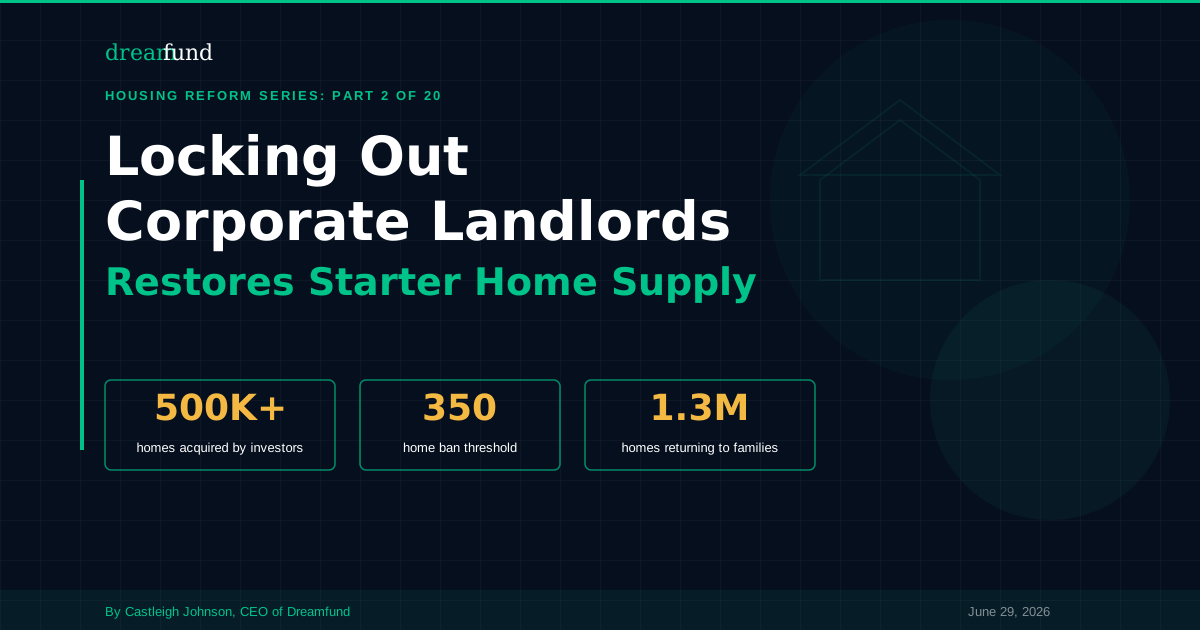
HOUSING REFORM SERIES: PART 2 OF 20 | 21st Century ROAD to Housing Act Deep Dive
For more than a decade, institutional investors swept through starter home markets with billion-dollar credit lines and algorithmic bidding tools. Section 1001 of the ROAD Act ends that era permanently.
Wall Street just lost its golden ticket to outbid your family for starter homes.
For the better part of a decade and a half, institutional investors treated single-family neighborhoods the way venture capitalists treat seed rounds: buy fast, buy in bulk, and hold until the returns justify the portfolio. The families who actually wanted to live in those homes had no chance. They were competing against entities with billion-dollar credit lines, algorithmic bidding tools, and zero interest in putting down roots. Section 1001 of the 21st Century ROAD to Housing Act changes that dynamic permanently.
The Scale of the Problem
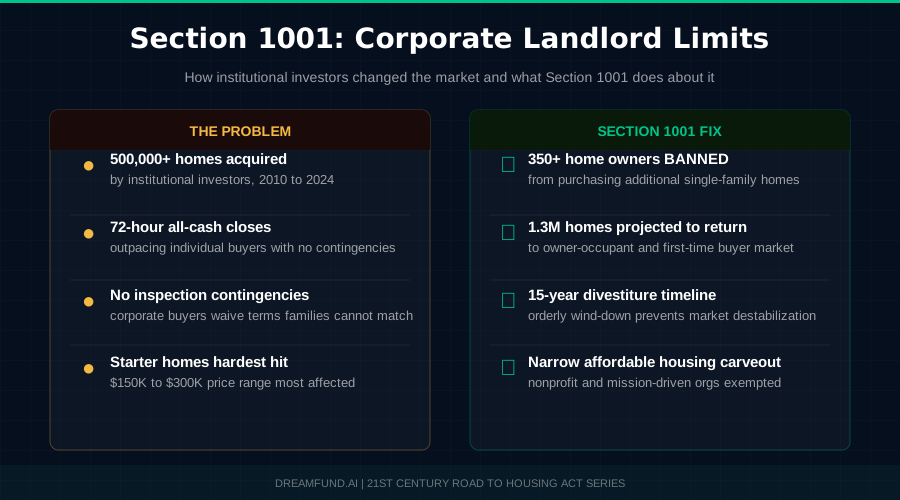
Between 2010 and 2024, institutional investors acquired more than 500,000 single-family homes across the United States. This was not a scattered trend. It was a coordinated capital strategy concentrated in exactly the markets where first-time buyers were most active.
In Atlanta, large investor purchases accounted for a significant share of single-family acquisitions in several zip codes, pushing median prices well above the affordability threshold for households earning the area median income. In Phoenix, where population growth already strained supply, institutional buying amplified price appreciation at the entry-level tier. In Dallas, starter home inventory shrank not because demand slowed but because a growing percentage of available units never re-entered the for-sale market. They were absorbed into rental portfolios and stayed there.
The effect was not limited to price. Inventory compression meant that buyers who showed up qualified, pre-approved, and ready to close still lost. They lost to cash offers that closed in 72 hours. They lost to buyers who did not need inspection contingencies because they were not planning to live in the home. They lost to a financial machine that was playing a different game entirely.
The starter home segment bore the sharpest impact. These are the properties priced between roughly $150,000 and $300,000 depending on the market. They are the entry point into homeownership for most first-generation buyers, most buyers of color, and most families earning between 80 and 120 percent of the area median income. When institutional capital swept through this tier, it did not just raise prices. It eliminated pathways.
What Section 1001 Does
Section 1001 of the ROAD Act establishes a targeted ban on single-family home purchases by large institutional investors in designated markets. The threshold is meaningful: entities that own 350 or more single-family homes are prohibited from acquiring additional units in covered markets.
The mechanics matter. The ban is not a soft guideline or a reporting requirement with modest penalties. It is a structural prohibition with enforcement teeth. Covered investors cannot close on restricted transactions in designated markets, and the designation criteria are tied to affordability stress indicators including price-to-income ratios, inventory turnover rates, and rental conversion activity.
There are exemptions. Affordable housing developers, community land trusts, and entities operating under specific public-benefit structures can continue acquiring single-family properties where doing so advances affordability goals. The carveout is deliberately narrow. It is designed to protect mission-driven acquisition, not to create a loophole that institutional capital can route through with cosmetic restructuring.
Enforcement combines federal oversight with state-level implementation authority. This layered structure gives high-cost metros and states with acute inventory shortages the ability to move quickly without waiting for federal administrative timelines.
The Inventory Return Projection
The downstream effect of Section 1001 extends beyond blocking new purchases. Because the ban creates holding costs and strategic uncertainty for large portfolios, analysts project that institutional investors will begin divesting single-family holdings in covered markets over the next several years.
The projected return: approximately 1.3 million starter homes shifting from Wall Street portfolios to owner-occupant families over a 15-year period. This is not an overnight correction. The divestiture will be gradual, shaped by local market conditions, portfolio financing structures, and the pace of designation enforcement. But the directional shift is clear.
In the near term, meaning the next three to five years, the most immediate impact will be felt in markets with the highest concentration of institutional ownership. Atlanta, Phoenix, Dallas, Charlotte, and Tampa are among the metros where analysts expect the earliest inventory releases. Buyers in these markets who have been priced out or outbid will begin to see more properties re-entering the for-sale market, and they will be competing against other families rather than algorithms.
What Buyers Should Do Right Now
Inventory normalization takes time. Section 1001 was signed into law, not a market reset button. The homes do not reappear overnight, and the buyers who will benefit most are the ones who are prepared before the supply comes back.
That means being financially ready. It means having the down payment saved. It means having the pre-approval in hand. It means knowing your target market and your price range so that when a property comes available, you can move.
This is where Dreamfund's approach becomes directly relevant. The buyers who win when inventory returns are not the ones who start saving after the law takes effect. They are the ones who have been systematically building toward this moment. With friends, family, and employers able to contribute directly to a homebuyer's down payment savings goal, the community-backed model accelerates the timeline. You are not saving alone. You are mobilizing a network.
Section 1001 is reopening the door. The buyers who have been building their down payment while waiting for that door to open are the ones who will walk through it first.
The Bigger Picture
The ROAD Act's Section 1001 does not solve the housing crisis on its own. Supply constraints, zoning restrictions, and construction costs are structural issues that require their own legislative and local responses. But removing institutional buyers from the starter home market is a foundational step. It restores the segment to the purpose it has always served: providing families with an affordable first rung on the ladder to generational wealth.
For first-time buyers who have watched prices rise, been outbid by investors, and wondered whether ownership was still possible, Section 1001 is a signal that the policy environment is shifting in your direction. The work of getting ready, building the savings, strengthening the credit, finding the right market, is still yours to do. But the competition you will face when you step into that market is finally starting to look fairer.
Frequently Asked Questions
What does Section 1001 of the ROAD Act do?
Section 1001 prohibits entities that own 350 or more single-family homes from purchasing additional units in designated markets. It is projected to return approximately 1.3 million starter homes from institutional portfolios to owner-occupant families over a 15-year period.
Which markets are most affected by the institutional investor ban?
Markets with the highest concentration of institutional single-family ownership are most affected. Atlanta, Phoenix, Dallas, Charlotte, and Tampa are among the metros where analysts expect the earliest inventory releases as investors begin divesting covered holdings.
Are there exemptions to the Section 1001 ban?
Yes. Affordable housing developers, community land trusts, and entities operating under specific public-benefit structures can continue acquiring single-family properties. The carveout is narrow and designed to protect mission-driven acquisition rather than create a loophole.
How does Section 1001 help first-time buyers specifically?
By removing institutional competition from the starter home segment (properties priced between approximately $150,000 and $300,000), Section 1001 restores a segment that serves first-generation buyers, buyers of color, and families earning 80–120 percent of area median income. Buyers will compete against other families rather than algorithmic bidding systems.
Build your down payment with your community behind you.
Dreamfund is purpose-built for the ROAD Act era: AI-powered, community-backed, and lender-compliant from day one.
Join the waitlistDreamfund is not a bank and does not hold customer funds. Upon launch, each customer's savings will be held in a deposit account opened in the customer's own name at an FDIC-member institution. FDIC deposit insurance applies to deposits at the member bank subject to applicable limits. Dreamfund itself is not FDIC-insured and does not guarantee any savings outcome. This content is for informational purposes only and does not constitute financial, legal, or investment advice.