Why the 21st Century ROAD to Housing Act Changes Everything for the American Homebuyer
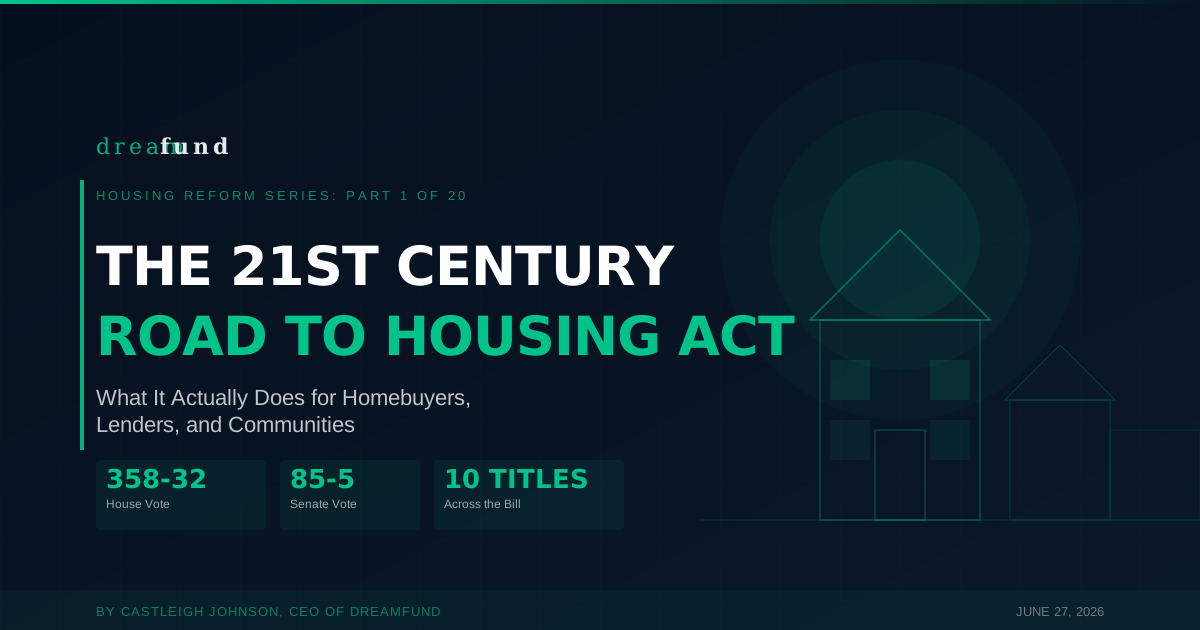
HOUSING REFORM SERIES: PART 1 OF 20 | 21st Century ROAD to Housing Act Deep Dive
Congress passed the most comprehensive federal housing reform in more than three decades. Here is what the 21st Century ROAD to Housing Act actually does, title by title, and why it matters for every buyer, lender, employer, and housing authority in America.
The ink is barely dry on the legislative text, but history has officially been made. Congress has passed the 21st Century ROAD to Housing Act, clearing the House 358 to 32 and the Senate 85 to 5. This is not merely an incremental adjustment to lending rules or a minor package of compliance items. It represents the most comprehensive, system-wide overhaul of American federal housing policy enacted in more than three decades.
For millions of working families, young professionals, and first-time buyers who have watched the cost of homeownership skyrocket over the last few years, this moment is a turning point. We have transitioned out of a defensive holding pattern and moved into an era of proactive expansion.
The Standard Path Has Been Broken for a Long Time
The standard path to purchasing a first home has been fundamentally broken for a long time. Consider the baseline reality of the modern real estate environment. First-time homebuyers have collapsed to a record low of just 21 percent of all market transactions. In stark contrast, during the 1980s, that same group represented roughly 40 percent of total buyers. Concurrently, the median age of a first-time purchaser has climbed to an astonishing 40 years old, up from age 28 in 1991.
The primary culprit behind this crisis has never been credit scores or stable employment income. The true culprit is the gatekeeping barrier of the upfront down payment. With the median down payment hovering above $30,000, the typical American renter family requires seven long years of aggressive saving just to pull together the initial entry fee. While families scramble to build these savings, home equity values compound away from them.
This dynamic has resulted in an economy where the median net worth of a property owner is approximately $400,000 compared to a minuscule $10,400 for a renter family. That is a staggering 38-fold wealth gap. This divide directly underscores the absolute necessity of the legislative intervention we are witnessing.
What the ROAD Act Actually Does
The 21st Century ROAD to Housing Act attacks this structural divide from multiple angles simultaneously. The legislation spans 10 titles, each targeting a different layer of the housing access problem.
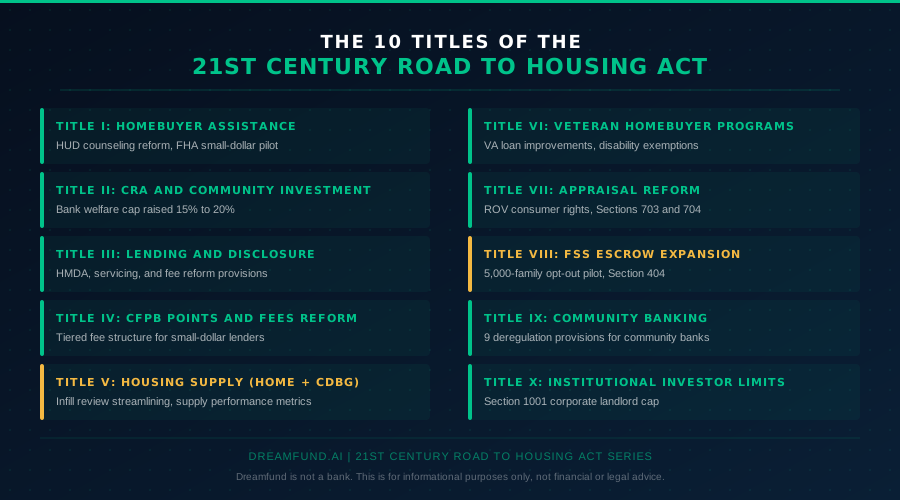
Over the coming weeks, Dreamfund will publish a comprehensive 20-part exploratory series breaking down this sweeping legislation section by section. Below is a preview of the major provisions.
Title X: Institutional Investor Limits (Section 1001)
Section 1001 places unprecedented, aggressive limits on large institutional investors buying single-family homes. This single provision is projected to salvage 1.3 million starter homes from Wall Street portfolios and return them directly to owner-occupant families over the next fifteen years. For buyers competing against investment algorithms in markets like Atlanta, Dallas, and Phoenix, this is the most immediate structural change in the entire bill.
Title I: Homebuyer Assistance (Section 105)
Section 105 establishes a dedicated FHA Small-Dollar Mortgage Pilot to explicitly revitalize lending infrastructure for entry-level homes priced under $100,000. For years, the math on small-dollar origination was broken for lenders: fixed costs plus the existing 3 percent fee cap made sub-$100K loans economically unviable. Section 105 directly addresses that math. This reopens hundreds of thousands of affordable entry-level homes in legacy cities that had effectively disappeared from the mortgage market.
Title VIII: FSS Escrow Expansion (Section 404)
Section 404 transforms the Family Self-Sufficiency program by launching a streamlined, opt-out Escrow Expansion Pilot, allowing families in public housing to build matched savings accounts directly without old bureaucratic roadblocks. The pilot targets 5,000 families in its first phase, with the potential to scale to the 2 million eligible FSS households nationwide who currently have no structured path to a down payment.
Title VII: Appraisal Reform (Sections 703 and 704)
Sections 703 and 704 establish formal consumer reconsideration of value rights in the appraisal process. Freddie Mac research found valuations in majority-Black neighborhoods came in 48 percent lower than comparable properties in majority-white neighborhoods. These provisions give buyers a structured, time-limited right to challenge appraisals and require appraisers to specifically address buyer-submitted evidence.
Title IX: Community Banking Modernization
Title IX contains nine separate deregulation provisions specifically designed for community banks and credit unions with assets under $10 billion. These institutions have historically been the primary origination channel for first-time buyers in secondary and rural markets. The provisions ease qualified mortgage requirements, capital calculation rules, and exam reporting burdens that have made small-institution mortgage lending increasingly difficult over the past decade.
The Execution Gap Nobody Is Talking About
Crucially, this legislation contains a final section mandating that agencies implement these sprawling programs with no additional authorized funds. This means our federal departments and public housing authorities must absorb complex new pilots within their existing operational infrastructure.
It is an execution gap that traditional government structures cannot bridge on their own. It demands modern, agile, compliant technology purpose-built for these programs.
At Dreamfund, we did not wait for the regulatory landscape to improve. We intentionally engineered an AI-powered, community-backed financial infrastructure designed specifically to meet these exact challenges. We built our platform to act as the direct implementation engine for the exact tools Congress has now codified into law.
Whether you are an aspiring buyer trying to navigate a shifting market, a community lender looking to scale compliant originations, or a civic housing authority tasked with managing complex escrow expansions, this 20-part series is designed to serve as your tactical execution playbook.
The road to expanded, equitable homeownership is open. Let us map it out together.
Frequently Asked Questions
What is the 21st Century ROAD to Housing Act?
The 21st Century ROAD to Housing Act is a comprehensive federal housing law passed by Congress in 2026 with a 358-32 House vote and an 85-5 Senate vote. It addresses the down payment barrier, institutional investor concentration in single-family homes, FHA lending for small-dollar mortgages, Family Self-Sufficiency escrow expansion, appraisal consumer rights, and community banking modernization across 10 titles.
What does Section 1001 of the ROAD Act do?
Section 1001 places limits on large institutional investors purchasing single-family homes. It is projected to return approximately 1.3 million starter homes from institutional portfolios to owner-occupant families over the next fifteen years, particularly in markets like Atlanta, Dallas, and Phoenix where institutional concentration has been highest.
What is the FHA Small-Dollar Mortgage Pilot in the ROAD Act?
Section 105 establishes an FHA pilot program to revitalize lending for homes priced under $100,000. It addresses the fee structure that made small-dollar lending unprofitable for lenders, reopening entry-level inventory in secondary and legacy cities that had effectively disappeared from the mortgage market.
What is the FSS Escrow Expansion in the ROAD Act?
Section 404 transforms the Family Self-Sufficiency program by launching a streamlined, opt-out Escrow Expansion Pilot. It allows families in public housing to build matched savings accounts that can be used toward a home down payment, targeting 5,000 families in Phase 1 with potential to scale to 2 million eligible households.
How does the ROAD Act affect the homeownership wealth gap?
The ROAD Act directly targets the structural causes of the homeownership wealth gap. With homeowner median net worth at approximately $400,000 versus $10,400 for renters, a 38-fold difference, the Act addresses the down payment barrier, investor concentration in starter homes, FHA small-dollar lending, and appraisal bias to expand access to the primary vehicle of wealth-building in America.
Build your down payment with your community behind you.
Dreamfund is purpose-built for the ROAD Act era: AI-powered, community-backed, and lender-compliant from day one.
Join the waitlistDisclaimer: This article is for informational purposes only and does not constitute financial, legal, or investment advice. Legislative summaries are based on publicly available bill text and may not reflect implementing regulations or agency guidance issued after publication. Consult qualified legal and financial professionals for advice specific to your situation.
Dreamfund is not a bank and does not hold customer funds. Upon launch, each customer's savings will be held in a deposit account opened in the customer's own name at an FDIC-member institution. FDIC deposit insurance applies to deposits at the member bank subject to applicable limits. Dreamfund itself is not FDIC-insured and does not guarantee any savings outcome.