Section 404: 5,000 Families and the FSS Escrow Expansion Pilot
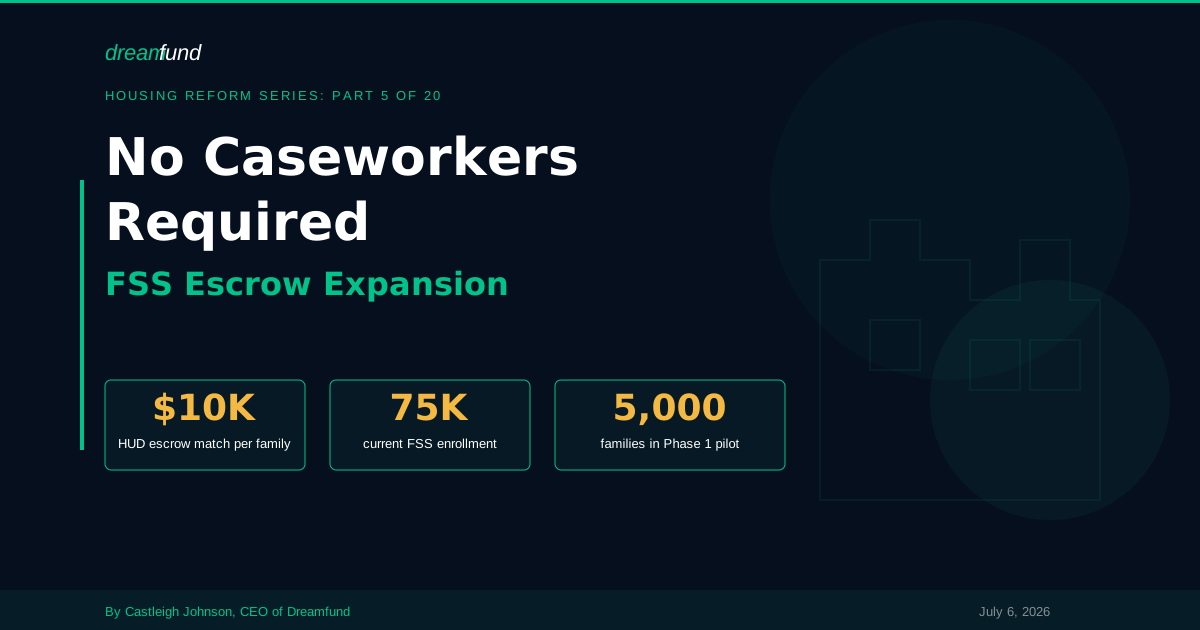
HOUSING REFORM SERIES: PART 5 OF 20 | 21st Century ROAD to Housing Act Deep Dive
HUD has matched savings for public housing families since 1990. The program reached fewer than 75,000 households because a dedicated caseworker was required for each one. Section 404 of the ROAD Act eliminates that bottleneck.
Federally matched down payments without the bureaucratic red tape are officially here. Section 404 of the 21st Century ROAD to Housing Act takes one of HUD's most underutilized savings tools and redesigns it from the ground up for the digital age. The Family Self-Sufficiency (FSS) Escrow Expansion Pilot is not a minor tweak. It is a structural shift in how public housing families can build wealth toward homeownership.
What Is the FSS Escrow Account and Why Does It Matter?
The Family Self-Sufficiency program has existed since 1990, but most Americans have never heard of it. When a public housing or Housing Choice Voucher participant increases their earned income, HUD credits the difference between their old rent payment and their new, higher rent payment into an escrow account. Families who complete the program receive those escrow funds outright. No repayment. No clawback. A direct savings match funded by federal dollars.
HUD matches up to $10,000 in escrow savings per participating family. The data on outcomes has been encouraging. FSS completers show higher rates of employment, higher incomes, and higher rates of homeownership than comparable non-participants.
The Old Model and Its Structural Limits
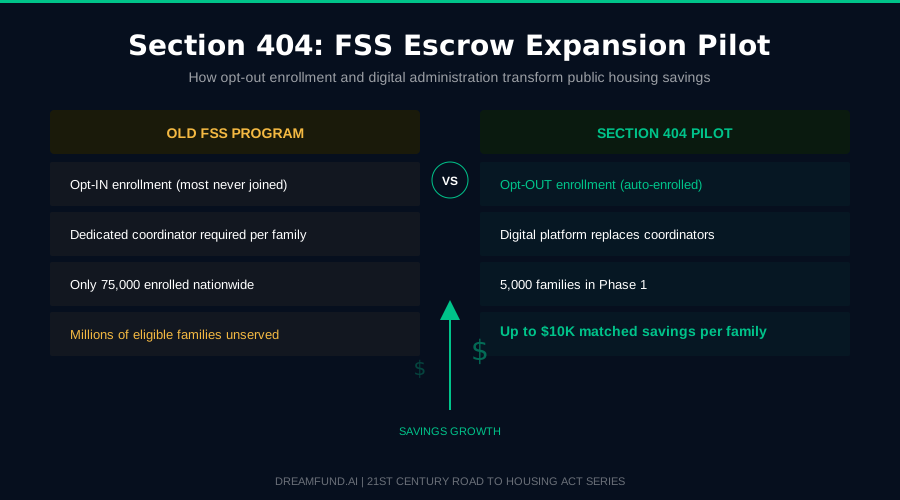
Under the pre-ROAD Act model, every FSS participant required a dedicated Program Coordinator. For small and mid-sized Public Housing Authorities, this created an impossible math problem. A PHA with limited staff could only administer as many FSS slots as it had coordinators to manage.
Nationally, fewer than 75,000 households were enrolled in FSS out of millions of eligible voucher holders. The coordinator bottleneck was the primary constraint.
What Section 404 Changes
Section 404 creates an opt-out Escrow Expansion Pilot. Under opt-out, eligible families are automatically enrolled and must take action to leave. Behavioral economics research is clear: opt-out designs produce dramatically higher participation rates.
The pilot is authorized for up to 5,000 families. Section 404 also explicitly authorizes PHAs to administer the pilot through digital platforms rather than dedicated coordinators. Escrow calculations, milestone tracking, and participant communications can be automated.
How Dreamfund's Platform Is Built for This Moment
Dreamfund's white-label PHA dashboard engine is designed to handle the mechanics Section 404 envisions: automated escrow tracking, milestone-based notifications, digital enrollment and opt-out workflows, and participant-facing interfaces that make the program accessible without requiring a coordinator for every family.
PHAs using the Dreamfund platform can administer FSS escrow accounts alongside community gifting, employer contribution programs, and other down payment assistance tools in a single unified dashboard.
The Bigger Picture for Renters
The families who stand to benefit most from the FSS Escrow Expansion Pilot are the same families who have been locked out of homeownership pathways for the longest time. A $10,000 federally matched escrow account, accumulated through normal income growth and automatically administered, is a real and tangible step. Multiplied across 5,000 pilot families, and eventually millions of eligible households, the aggregate wealth-building impact is substantial.
The coordinator bottleneck was never a design requirement. It was a legacy constraint. Section 404 removes it. Digital platforms like Dreamfund are built to fill the gap at scale.
Frequently Asked Questions
What is the Family Self-Sufficiency Escrow Expansion Pilot?
Section 404 creates an opt-out FSS Escrow Expansion Pilot that automatically enrolls eligible public housing families. When participants increase their earned income, HUD credits the rent difference into a savings escrow. Families who complete the program receive up to $10,000 in matched savings with no repayment required.
How is the new FSS pilot different from the old program?
The key changes are the opt-out enrollment design, which dramatically increases participation versus the old opt-in model, and the authorization of digital platform administration, which removes the coordinator bottleneck that kept the program small. PHAs no longer need a dedicated staff coordinator for every enrolled family.
Who is eligible for the FSS Escrow Expansion Pilot?
Families participating in public housing or Housing Choice Voucher programs who increase their earned income are eligible. The pilot targets 5,000 families in Phase 1, with potential for broader expansion based on performance data.
How does Dreamfund support FSS program administration?
Dreamfund's white-label PHA dashboard handles automated escrow tracking, milestone-based notifications, digital enrollment and opt-out workflows, and participant-facing interfaces. PHAs can administer FSS alongside community gifting and employer contribution programs in a single platform, reducing staff burden while serving more families.
Build your down payment with your community behind you.
Dreamfund is purpose-built for the ROAD Act era: AI-powered, community-backed, and lender-compliant from day one.
Join the waitlistDreamfund is not a bank and does not hold customer funds. Upon launch, each customer's savings will be held in a deposit account opened in the customer's own name at an FDIC-member institution. FDIC deposit insurance applies to deposits at the member bank subject to applicable limits. Dreamfund itself is not FDIC-insured and does not guarantee any savings outcome. This content is for informational purposes only and does not constitute financial, legal, or investment advice.