The 3 Percent Problem Is Fixed: Sections 401 and 402 and the Small-Dollar Lending Revival
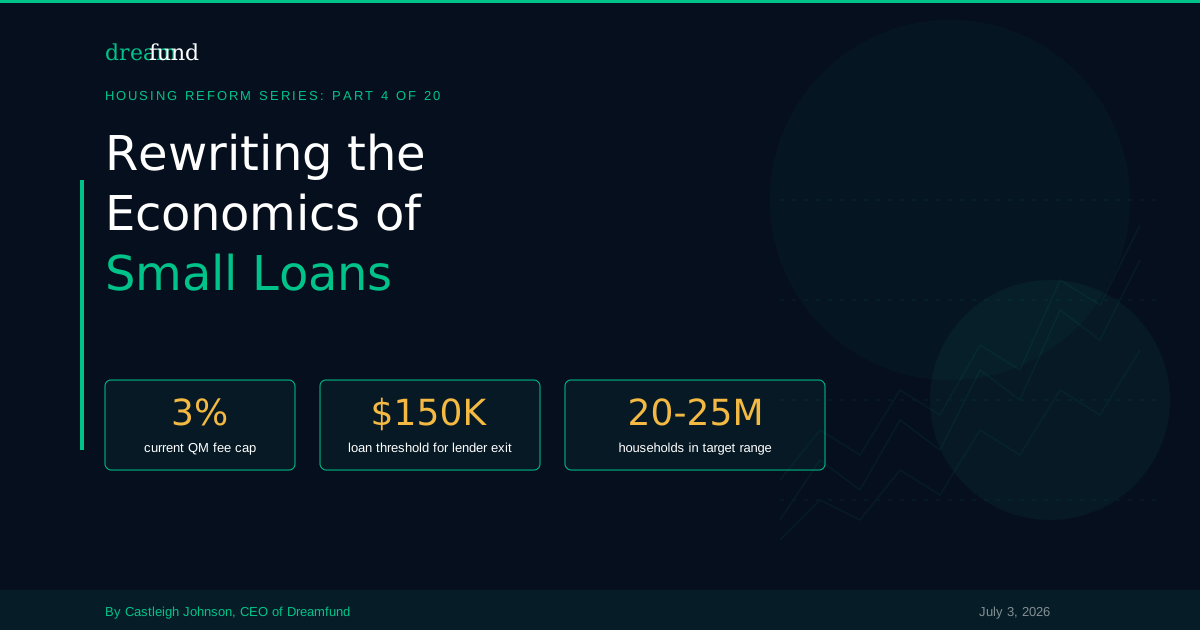
HOUSING REFORM SERIES: PART 4 OF 20 | 21st Century ROAD to Housing Act Deep Dive
The 3 percent QM fee cap works on large loans. On a $100,000 loan, it caps recoverable costs at $3,000 and locks lenders out of the market. Sections 401 and 402 of the ROAD Act direct the CFPB to fix that math.
Why the least profitable loans on your balance sheet are about to become your strongest growth pipeline.
That is not a marketing headline. It is the practical consequence of Sections 401 and 402 of the 21st Century ROAD to Housing Act, which direct the Consumer Financial Protection Bureau to fundamentally rethink the economics of small-dollar mortgage origination. If your institution has been quietly exiting the sub-$150K loan market because the math never works, the regulatory environment is shifting in your direction.
The Problem the Market Already Knows
The CFPB's Qualified Mortgage rule capped points and fees at 3% of the loan amount for a loan to carry QM status. QM status provides lenders with the strongest legal protection against ability-to-repay claims.
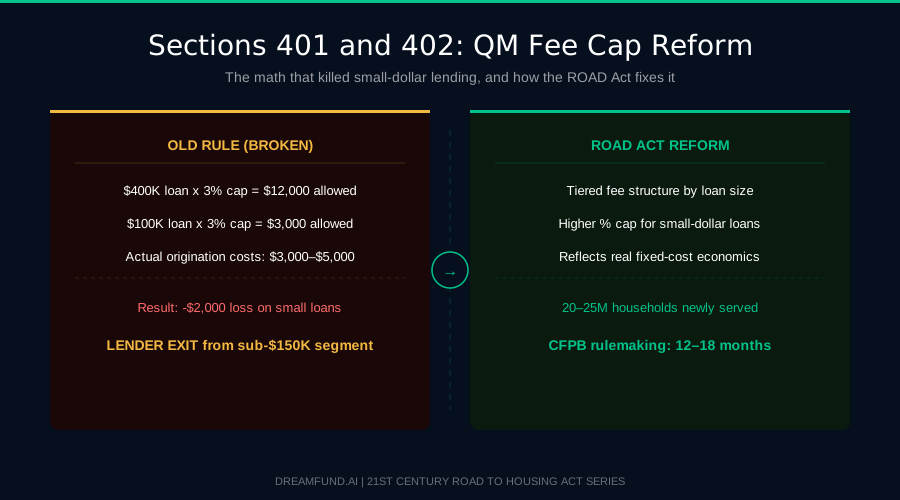
The 3% cap sounds reasonable on a $400,000 mortgage. On that loan, the cap allows up to $12,000 in points and fees. Run the same math on a $100,000 loan. The cap allows $3,000. The fixed costs of origination do not scale down proportionally. The result is a loan that often costs more to make than the fee ceiling permits lenders to recover.
The Urban Institute, the National Community Reinvestment Coalition, and multiple Federal Reserve studies have documented the collapse of small-dollar mortgage lending over the past decade. Loans under $150,000 have declined sharply as a share of total originations, and they disproportionately serve first-generation buyers, lower-income households, rural communities, and buyers in legacy markets.
What Sections 401 and 402 Direct the CFPB to Do
The ROAD Act addresses this directly. Section 401 directs the CFPB to revise the QM points-and-fees calculation methodology for small-dollar mortgages. Section 402 directs complementary revisions to loan originator compensation rules.
The reform framework envisions a tiered fee structure. Rather than a flat 3% cap applied uniformly across all loan sizes, the revised framework would allow a higher percentage cap for loans below defined balance thresholds, reflecting the reality that fixed origination costs represent a larger share of a small loan's economics.
The CFPB rulemaking timeline, once the Act passes, would follow standard notice-and-comment procedures. Realistically, a proposed rule could emerge within 12 to 18 months of enactment, with a final rule potentially landing in 2027 or 2028. Institutions that begin positioning now will not be scrambling to build pipelines when the window opens.
The Pipeline Implications for Community Banks and IMBs
The addressable market is substantial. Roughly 20 to 25 million American households are in the income range where a purchase price under $150,000 represents a realistic first home, particularly in secondary and tertiary markets.
For community banks and independent mortgage banks, the reformed framework creates a specific opportunity: pairing small-dollar QM origination with down payment assistance programs. This is where Dreamfund fits into the originator's workflow. When a buyer arrives at your institution pre-funded and ready to transact, the cost economics of originating the loan improve materially. The buyer is more prepared, the time-to-close is shorter, and the loan officer's effort per closed file decreases.
The Business Case for Moving Early
The institutions that will benefit most from the ROAD Act's small-loan reforms are not the ones who start thinking about this segment in 2028. They are the ones building originator capacity, community relationships, and DPA partnerships now.
That means training loan officers on small-dollar product economics. It means building referral pipelines with nonprofit housing counselors, employers, and platforms like Dreamfund that are already aggregating motivated, savings-committed buyers. It means being present in the communities where these transactions will happen before your competitors recognize the shift.
Frequently Asked Questions
What do Sections 401 and 402 of the ROAD Act do?
Section 401 directs the CFPB to revise the QM points-and-fees calculation methodology for small-dollar mortgages. Section 402 directs complementary revisions to loan originator compensation rules. Together, they address the economic barriers that have made sub-$150K mortgage origination unprofitable for lenders.
Why is the 3% QM fee cap a problem for small-dollar loans?
Fixed origination costs do not scale with loan size. On a $400,000 loan, the 3% cap permits $12,000 in fees. On a $100,000 loan, the same cap allows only $3,000, often less than actual origination costs. This makes small-dollar loans a loss leader that lenders have exited.
How long will it take for the CFPB to implement the new rules?
Following standard notice-and-comment rulemaking, a proposed rule could emerge within 12–18 months of enactment, with a final rule and compliance effective date potentially in 2027 or 2028. Institutions building small-dollar pipelines now will have a competitive advantage when the rule takes effect.
How does Dreamfund fit into lenders' small-dollar mortgage strategy?
Dreamfund aggregates savings-committed buyers who arrive with documented down payment savings and community gifting documentation. When buyers arrive pre-funded, lender time-to-close and per-file costs decrease, improving the economics of originating small-dollar loans even before the CFPB rule change takes effect.
Build your down payment with your community behind you.
Dreamfund is purpose-built for the ROAD Act era: AI-powered, community-backed, and lender-compliant from day one.
Join the waitlistDreamfund is not a bank and does not hold customer funds. Upon launch, each customer's savings will be held in a deposit account opened in the customer's own name at an FDIC-member institution. FDIC deposit insurance applies to deposits at the member bank subject to applicable limits. Dreamfund itself is not FDIC-insured and does not guarantee any savings outcome. This content is for informational purposes only and does not constitute financial, legal, or investment advice.