From 15 Percent to 20 Percent: Section 204 and the Community Investment Expansion
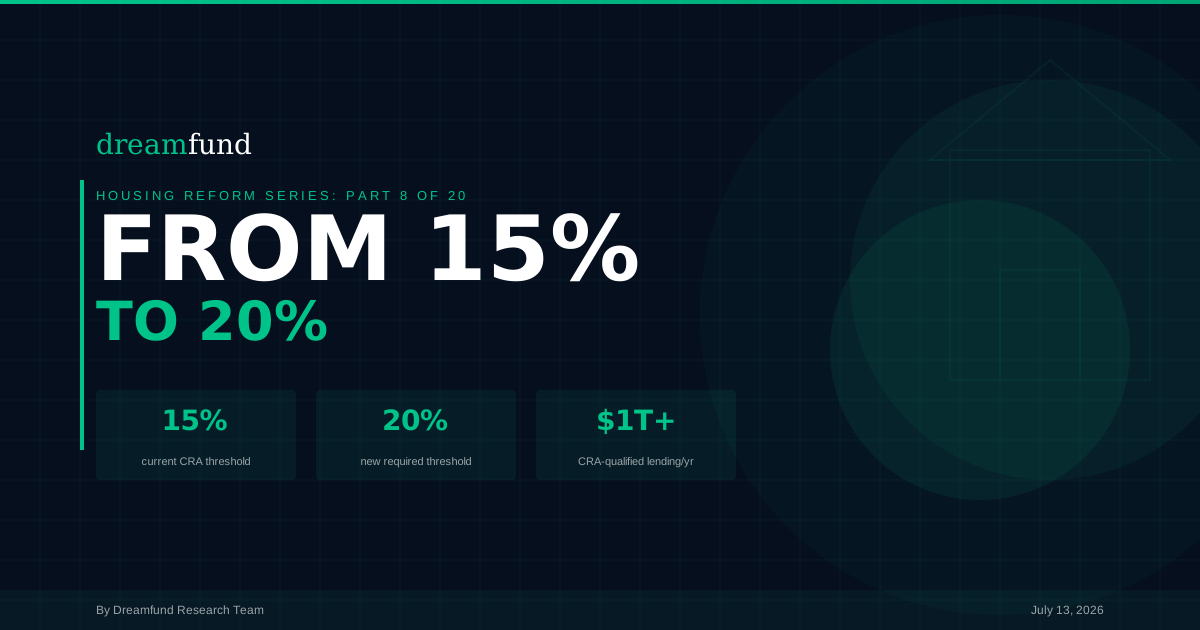
The Community Reinvestment Act is the federal government's most direct lever for directing bank capital toward underserved communities. The ROAD Act just turned that lever further.
What the Community Reinvestment Act Does
The Community Reinvestment Act of 1977 was Congress's response to redlining: the practice by which banks drew literal red lines around Black and brown neighborhoods and refused to lend there, even to creditworthy borrowers who had accounts at those same banks. The CRA requires that federally supervised financial institutions meet the credit needs of the communities in which they operate, with particular attention to low-to-moderate income neighborhoods.
CRA compliance is evaluated through periodic examinations conducted by federal bank regulators. Those examination ratings, Outstanding, Satisfactory, Needs to Improve, or Substantial Noncompliance, matter operationally. A bank with a weak CRA rating faces regulatory friction when it seeks to open new branches, pursue acquisitions, or merge with other institutions. That friction creates a real financial incentive to lend in underserved communities.
The 15% Threshold and Its Limits
Under the existing CRA framework, the investment activity component of a bank's examination includes a test for whether at least 15% of the bank's small-business and small-farm loans are made in low-to-moderate income census tracts. This threshold was designed to ensure a minimum floor of community reinvestment. In practice, it has functioned as both a floor and, effectively, a target: banks optimize to clear it rather than to exceed it.
The 15% floor has not kept pace with either the scale of housing need or the asset growth of the banks it regulates. A bank that has tripled in size since the threshold was set can satisfy the same percentage requirement with proportionally more capital deployed, but if home prices and community development needs have grown faster than bank assets, the real-world impact of that 15% can actually shrink over time.
What the ROAD Act Changes
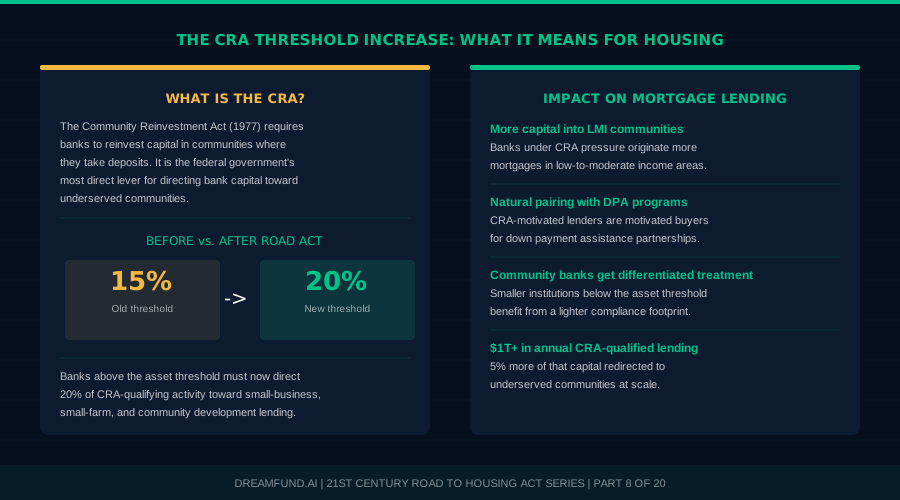
The ROAD Act raises the CRA investment activity threshold from 15% to 20% for banks above a certain asset size. This is a 33% increase in the required floor for community investment activity. For banks with tens or hundreds of billions in assets, a 5-percentage-point increase in the required allocation of CRA-qualifying activity represents a meaningful increase in capital deployed to underserved markets.
The practical mechanics work through the CRA examination framework. Banks that fail to meet the 20% threshold will face examination downgrades in the investment component of their assessment. Those downgrades reduce overall CRA ratings, which in turn create regulatory friction on the merger, acquisition, and expansion activity that large banks pursue regularly. The incentive structure is direct: meet the threshold or face competitive disadvantage.
Impact on Mortgage Lending in Underserved Markets
CRA pressure on community development investment naturally translates into pressure on mortgage origination in LMI areas. Mortgages originated in LMI census tracts count favorably in CRA examinations. Banks competing for strong CRA ratings have a documented incentive to develop mortgage products tailored to LMI borrowers, to partner with community development financial institutions that serve those markets, and to ensure their underwriting standards do not create artificial barriers for creditworthy borrowers in underserved areas.
More capital pressure toward LMI mortgage origination also creates demand for down payment assistance infrastructure. A bank motivated to originate more LMI mortgages needs borrowers who are prepared to close. DPA programs, community savings platforms, and employer housing benefits all feed the pipeline of buyers who are mortgage-ready. The CRA threshold increase creates the demand side of that equation. Platforms like Dreamfund build the supply side.
Community Banks and Credit Unions: Differentiated Treatment
Not every financial institution is subject to the same CRA examination framework. Community banks and credit unions below the asset threshold that triggers the higher 20% requirement continue to operate under a lighter compliance footprint. This differentiation is intentional. Congress recognized that the administrative burden of meeting a higher threshold should scale with institutional size. A community bank with $500 million in assets serving a rural LMI market operates differently from a $500 billion institution.
This differentiated treatment also creates an opportunity. Community banks that specialize in LMI markets can achieve strong CRA ratings with relatively modest absolute investment amounts. Their relationship-based lending models are often better suited to the documentation-intensive, relationship-dependent nature of first-time homebuyer mortgages than the volume-driven underwriting models of large national banks.
The Connection to Down Payment Assistance
The relationship between CRA-motivated lending and down payment assistance is structural, not incidental. A bank under CRA pressure to originate more LMI mortgages wants borrowers who are prepared to close without exceptional risk. A buyer who arrives with a fully documented, community-backed down payment is exactly that borrower. The down payment is documented, the source of funds is clean, and the borrower has demonstrated the financial discipline to save toward a goal.
Dreamfund is designed to produce precisely that borrower profile. Community contributions are tracked, documented, and structured as lender-compliant gifts. The savings history demonstrates commitment. The documentation package is built for the underwriting process. When the ROAD Act drives more CRA capital toward LMI mortgage origination, Dreamfund users are the buyers that capital is looking for.
Frequently Asked Questions
What is the Community Reinvestment Act and why does it matter for housing?
The Community Reinvestment Act of 1977 requires banks to reinvest capital in the communities where they take deposits. It is the federal government's primary tool for directing bank capital toward low-to-moderate income neighborhoods. CRA examinations evaluate how well banks are meeting the credit needs of their local communities, and CRA ratings affect a bank's ability to pursue mergers, acquisitions, and branch expansions.
What does the ROAD Act change about CRA requirements?
The ROAD Act raises the investment activity threshold in CRA assessment from 15% to 20% for banks above a certain asset size. This means larger banks must direct a greater share of their CRA-qualifying activity toward community development, small-business lending, and affordable housing investment in low-to-moderate income areas.
How does the CRA threshold increase affect mortgage lending in underserved communities?
CRA pressure motivates banks to originate more mortgages in LMI areas to maintain strong examination ratings. Raising the threshold increases that pressure, directing more capital toward mortgage origination and affordable housing development in underserved markets. Banks with weaker CRA ratings face regulatory friction on expansion, which creates a direct incentive to lend more in underserved communities.
What does the CRA change mean for first-time buyers in LMI areas?
More CRA-motivated capital in LMI markets means more mortgage products designed for first-time buyers in those areas, more competitive rates, and more willingness from lenders to work with down payment assistance programs. CRA-motivated lenders are natural partners for DPA platforms like Dreamfund because the combination of community savings and CRA lending creates a fully documented, lender-compliant homeownership pathway.
Build your down payment with your community behind you.
Dreamfund is purpose-built for the ROAD Act era: AI-powered, community-backed, and lender-compliant from day one.
Join the waitlistDisclaimer: Dreamfund is not a bank and does not hold customer funds. Upon launch, each customer's savings will be held in a deposit account opened in the customer's own name at an FDIC-member institution. FDIC deposit insurance applies to deposits at the member bank subject to applicable limits. Dreamfund itself is not FDIC-insured and does not guarantee any savings outcome. This content is for informational purposes only and does not constitute financial, legal, or investment advice.