🌟 Series Conclusion
The Dream Capital Score: A New Framework for Measuring Homeownership Readiness
Twenty articles. Ten titles. One piece of historic legislation. We close this series not with a summary of what Congress passed, but with a forward-looking question: where do you stand on the path to owning your home?
When we launched this series in late June, the 21st Century ROAD to Housing Act had just cleared Congress with historic bipartisan margins. We promised a comprehensive, section-by-section breakdown of what the legislation actually means for buyers, lenders, employers, housing authorities, and communities across America.
We covered all of it. Institutional investor caps. FHA small-dollar mortgage revival. FSS escrow expansion. Appraisal reform. Opportunity zone modernization. Employer-assisted housing. Community gifting infrastructure. CDBG supply incentives. Community banking relief. Gift tax strategy. Twenty pieces over six weeks, each one a standalone guide to a specific tool or policy change in the most comprehensive federal housing reform enacted in a generation.
The legislative landscape has shifted. The policy framework is clearer than it has been in years. Programs that were theoretical are now law. Tools that required political will to create now require only execution to deploy.
The final question is simple: given everything that is now available, where do you stand?
Why Credit Score Alone Is an Incomplete Picture
The American mortgage system has spent decades reducing homeownership readiness to a three-digit number. Your credit score matters. No one is arguing otherwise. It is a meaningful signal of creditworthiness and payment behavior, and it directly affects your interest rate, your loan program options, and whether you get approved at all.
But a credit score tells you almost nothing about your actual readiness to close on a home. A buyer with a 740 credit score and no down payment savings is not mortgage-ready. A buyer with a 680 credit score, $40,000 in documented savings, a strong community gifting campaign, and a completed HUD counseling certificate is in a fundamentally different position, even though their credit score alone does not reflect that.
The conventional mortgage industry has historically measured only what it can easily observe: credit history, income documentation, and current debt load. It has not had a good framework for measuring the forward-looking dimensions of readiness that actually determine whether a buyer will successfully close and maintain their mortgage over time.
The Dream Capital Score is our answer to that gap.
The Five Dimensions
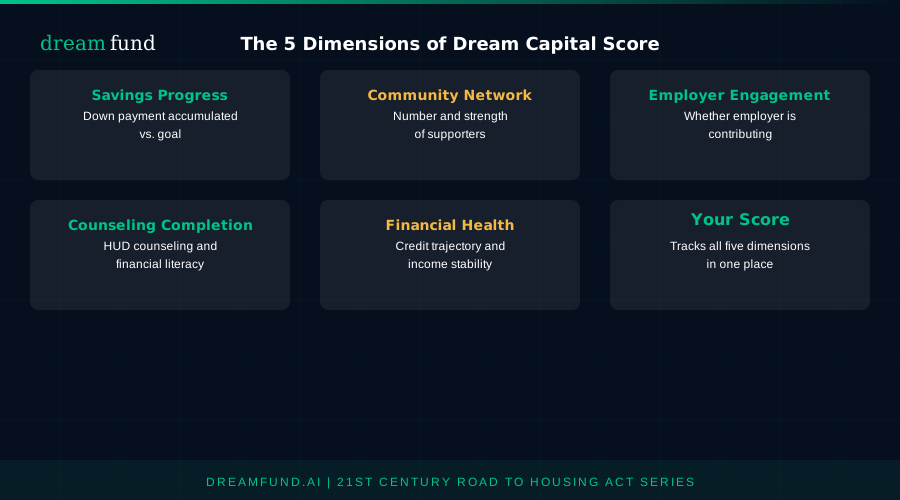
The Dream Capital Score tracks five dimensions that, taken together, provide a complete picture of where a buyer stands on the path to homeownership. Each dimension is measurable, trackable, and improvable. Each one corresponds directly to tools and programs that the ROAD Act has expanded or created.
Dimension 1: Savings Progress
The most fundamental dimension is the simplest to state and the hardest to achieve: how much of your down payment goal have you actually accumulated? Savings Progress measures the percentage of your target down payment that is documented, verified, and sitting in a designated account. It accounts for both your own contributions and community contributions through Dreamfund.
The ROAD Act's Title II down payment savings account provisions, FSS escrow expansion, and employer-assisted housing programs all directly improve a buyer's Savings Progress dimension. Every dollar added to a documented savings account moves this number forward.
Dimension 2: Community Network
The second dimension measures the strength and engagement of the buyer's support network. How many people are actively connected to the buyer's homeownership journey? How many have contributed? How consistently is the campaign active?
Research consistently shows that social accountability accelerates savings behavior. Buyers with active community networks save faster, maintain their savings goals more consistently, and are more likely to complete their down payment target. Community Network is not a soft metric. It is a behavioral predictor of successful homeownership completion.
The ROAD Act's community gifting framework, employer contribution provisions, and FSS program expansion all expand the potential contributors to a buyer's Community Network dimension.
Dimension 3: Employer Engagement
The third dimension tracks whether and how much a buyer's employer is participating in their homeownership journey. Employer-assisted housing benefits are one of the most underutilized tools in the homeownership ecosystem. Most buyers do not know whether their employer offers any housing benefit. Most employers that could offer one have not yet built the program.
The ROAD Act's Title VI employer-assisted housing provisions create significant tax incentives for employers to establish contribution programs. As those programs proliferate, the Employer Engagement dimension becomes increasingly actionable for buyers who know to ask for it.
A buyer with an active employer contribution is not just accumulating capital faster. They are demonstrating a stability of employment relationship that is independently valuable from an underwriting perspective.
Dimension 4: Counseling Completion
The fourth dimension tracks completion of formal financial literacy and housing counseling milestones. HUD-approved housing counseling has been shown in multiple studies to reduce mortgage default rates significantly. Buyers who complete pre-purchase counseling are better prepared for the financial realities of homeownership, make more informed decisions about loan products, and demonstrate to lenders a level of preparation that goes beyond credit score.
The ROAD Act expands and strengthens the HUD counseling infrastructure, making more counselors available in more markets and increasing the quality standards for approved programs. A completed counseling certificate is increasingly a signal that lenders and down payment assistance programs take seriously.
Dimension 5: Financial Health
The fifth dimension is the one most familiar to the mortgage industry: overall financial health, including credit score trajectory, debt-to-income management, and income stability. But the Dream Capital Score approaches this dimension differently from a standard credit pull.
Rather than taking a snapshot of creditworthiness at a single point in time, Dreamfund tracks trajectory. A buyer whose credit score has improved 40 points over 18 months is in a fundamentally different situation than a buyer whose score has been flat or declining at the same number. Trajectory tells the story that a static snapshot obscures.
The five dimensions work together. A buyer who is strong in Savings Progress but weak in Financial Health may need to prioritize credit repair before accelerating savings. A buyer strong in Financial Health but weak in Community Network may benefit from activating their support network before they have exhausted their personal savings capacity. The score shows where to focus.
What the ROAD Act Series Taught Us
Writing twenty articles about a single piece of legislation reveals something that no single policy summary can convey: the breadth of the challenge Congress was trying to address, and the intentionality of the solution architecture they built.
The homeownership gap in America is not one problem. It is a system of interlocking problems. The down payment barrier is real, but it is compounded by institutional investor concentration in starter homes, by appraisal bias in majority-minority neighborhoods, by the economic unviability of small-dollar FHA lending, by the retreat of community banks from underserved markets, by the absence of employer housing benefits at most mid-sized companies, and by a supply shortage driven by decades of local government restriction.
The ROAD Act addresses each of these vectors with a specific tool. Section 1001 hits investor concentration. Section 105 hits small-dollar lending. Section 404 hits the FSS savings gap. Title VII hits appraisal bias. Title IX hits community bank economics. Title VI hits employer engagement. The Build Now Act hits supply restriction. Title II hits the savings account infrastructure gap.
No single provision solves the homeownership affordability crisis. But the combination of all ten titles creates a comprehensive infrastructure that makes homeownership achievable for a significantly larger share of the American population than has been possible in the recent past.
Where Dreamfund Sits in This Landscape
Dreamfund was not built in response to the ROAD Act. We were already building when the legislation passed, because the problems the Act addresses were already clearly visible in the data and in the stories of the buyers we were talking to.
What the ROAD Act did was validate and expand the infrastructure we were building. The community gifting model we designed aligns directly with the gift fund documentation requirements that lenders enforce. The employer contribution framework we built anticipates the Title VI incentive structure. The savings account architecture we created is the private-sector complement to the Title II tax-advantaged account provisions.
We are not a government program. We are the technology layer that makes the government programs and private market mechanisms work together for the buyer who is trying to navigate all of it simultaneously.
The Dream Capital Score is how we give buyers a single, clear view of that entire picture. Not just their credit score. Not just their savings balance. The complete five-dimension picture of where they stand and what they need to do next.
A Note to Everyone Who Followed This Series
If you read all twenty installments of this series, you now understand the 21st Century ROAD to Housing Act better than most housing professionals, most lenders, and most real estate agents currently do. That knowledge is an asset.
Use it. Ask your employer about housing benefits. Understand your gift fund documentation rights. Know what CDBG performance metrics mean for your market. Understand the FSS program if you are in public housing. Know that FHA small-dollar mortgages are coming back to your market. Know that appraisal reconsideration rights now exist.
The road to homeownership is not easy. It has never been easy. But it is more navigable now than it was a year ago, and Dreamfund is here to walk every mile of it with you.
Thank you for reading.
Frequently Asked Questions
What is the Dream Capital Score?
The Dream Capital Score is a five-dimension framework developed by Dreamfund to measure a buyer's overall homeownership readiness. The five dimensions are savings progress, community network strength, employer contribution engagement, completion of financial literacy and HUD counseling, and overall financial health including credit trajectory and income stability.
How is the Dream Capital Score different from a credit score?
A credit score measures creditworthiness based on borrowing and repayment history. The Dream Capital Score measures homeownership readiness across five dimensions that go beyond credit, including accumulated down payment capital, community support network strength, employer contribution participation, and housing counseling completion. It is a forward-looking readiness measure, not a backward-looking credit assessment.
What are the five dimensions of the Dream Capital Score?
The five dimensions are: (1) Savings Progress, measuring accumulated down payment versus goal; (2) Community Network, measuring the number and engagement level of supporters; (3) Employer Engagement, measuring whether and how much an employer is contributing; (4) Counseling Completion, tracking HUD-approved housing counseling milestones; and (5) Financial Health, assessing credit score trajectory, income stability, and debt management.
How does Dreamfund use the Dream Capital Score?
Dreamfund tracks all five Dream Capital Score dimensions within the platform. Buyers can see their progress across each dimension in real time, understand which areas to prioritize, and demonstrate their readiness to lenders and housing counselors. The score gives lenders a structured view of a buyer's overall preparation beyond the standard credit and income metrics.
Series Complete
You have finished the 21st Century ROAD to Housing Act: 20-Part Deep Dive
Start from the beginning: Part 1. Why the ROAD Act Changes Everything →Your Dream Capital Score is waiting.
Join Dreamfund to start building all five dimensions of your homeownership readiness. Community-backed. Lender-compliant. Purpose-built for the ROAD Act era.
Join the waitlistDisclaimer: This article is for informational purposes only and does not constitute financial, legal, or investment advice. Legislative summaries are based on publicly available bill text and may not reflect implementing regulations or agency guidance issued after publication. Consult qualified legal and financial professionals for advice specific to your situation.
Dreamfund is not a bank. Upon launch, customer funds will be held in custodial accounts at an FDIC-member institution; FDIC insurance applies to deposits at the member bank subject to applicable limits. Dreamfund itself is not FDIC-insured.