24 Percent of Buyers Use Family Help: Community Gifting Is Already How Homes Get Bought
HOUSING REFORM SERIES: PART 16 OF 20 | 21st Century ROAD to Housing Act Deep Dive
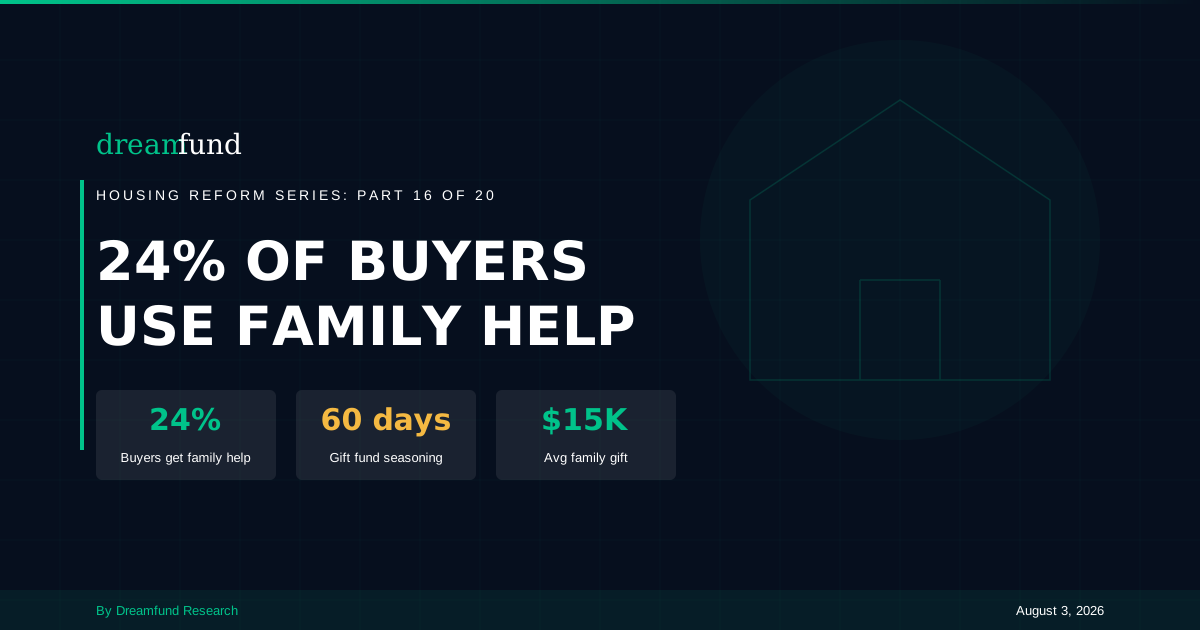
Nearly one in four first-time buyers receives some form of financial help from family. The challenge is that a well-meaning gift can actually derail a mortgage application if it is not documented correctly. Here is how to do it right.
One of the least-discussed but most common realities of first-time home buying is this: a significant portion of buyers do not get there alone. According to the National Association of Realtors, approximately 24 percent of first-time homebuyers receive some form of financial assistance from family members toward their down payment. Parents, grandparents, aunts, uncles, and siblings have been quietly subsidizing the American homeownership dream for decades.
But here is the problem most families do not know about until it is too late. An improperly documented gift can create serious complications during mortgage underwriting. Lenders are not just looking at whether you have the money. They are looking at where the money came from, how it arrived, and whether there is any obligation to repay it. A gift that looks like a loan on paper can disqualify a buyer entirely.
This installment of our 20-part ROAD Act series focuses on how the community gifting provisions in the legislation interact with existing mortgage guidelines, and how platforms like Dreamfund are building the infrastructure to make family contributions lender-compliant from the moment they arrive.
Why Gift Funds Are a Mortgage Minefield
From the lender's perspective, a down payment gift raises three separate compliance concerns that must each be satisfied before the loan can close.
The first concern is anti-money-laundering verification. Federal regulations require lenders to verify the source of all funds used in a real estate transaction. A large cash transfer from an unknown party raises flags. The lender needs to confirm that the money came from a legitimate, documented source: a savings account, an investment account, proceeds from a sale, or other verifiable origin.
The second concern is the nature of the transfer itself. Mortgage guidelines require that a down payment gift be a true gift with absolutely no expectation of repayment. If the transfer looks like a personal loan, the lender must treat it as a liability on the borrower's debt-to-income ratio. That can push a perfectly qualified buyer over the edge into a denial.
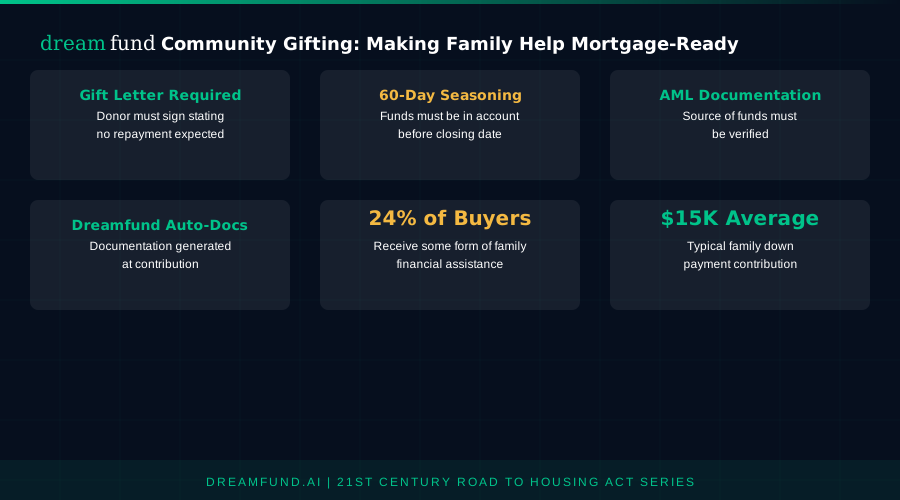
The third concern is timing. Funds that have been sitting in the buyer's account for less than 60 days are typically considered unseasoned. Unseasoned funds require full documentation of their origin. The longer the money has been in the account, the fewer documents the lender generally requires.
What a Compliant Gift Letter Must Include
Every mortgage gift requires a signed gift letter. This is a formal document, not a casual note. The contents must typically include:
- The full legal name and address of the donor
- The full legal name of the borrower (buyer)
- The property address for which the gift will be used
- The dollar amount of the gift
- The date the funds were or will be transferred
- A clear statement that the gift is not a loan and requires no repayment
- The signature of the donor
Some lenders also require a statement explaining the relationship between the donor and the buyer, and a copy of the donor's bank statement showing the funds leaving their account plus the buyer's bank statement showing the funds arriving.
The documentation burden is real. For a family quietly trying to help a loved one buy a home, navigating lender requirements can feel like running a bureaucratic obstacle course at the most stressful moment of their financial lives.
How the ROAD Act Addresses Community Gifting
The 21st Century ROAD to Housing Act does not eliminate the documentation requirements around gift funds. Those requirements exist for legitimate consumer protection and anti-fraud reasons. What the Act does is create a more structured and formally recognized framework for community-sourced contributions toward homeownership.
The legislation's provisions around employer-assisted housing, FSS escrow expansion, and down payment assistance all operate on the same underlying principle: community gifts, when properly documented and tracked, should be treated as a legitimate and valued pathway to homeownership. The Act reinforces the legitimacy of the community funding model at the federal policy level.
This matters because it shifts the posture of lenders and regulators. Rather than viewing community contributions with suspicion, the regulatory framework now explicitly endorses them as part of the intended homeownership pipeline.
The Dreamfund Approach to Gift Compliance
Dreamfund was built specifically to solve the documentation problem that trips up so many family gift scenarios. Every contribution made through the Dreamfund platform generates automatic documentation at the moment of transaction.
When a supporter contributes to a buyer's campaign, the platform produces a timestamped gift letter with legally required language, a source-of-funds audit trail, and a transfer record. The buyer receives a complete documentation package that has been designed to meet standard mortgage underwriting requirements.
This eliminates the most common failure mode in family gift scenarios: the buyer arrives at underwriting with money in their account but no paperwork. Lenders ask for documentation that no one thought to prepare. Closing gets delayed. Sometimes it falls apart entirely.
The Gifting Network Effect
There is a broader dynamic worth understanding here. When family financial support is formalized through a structured platform, it does not just benefit the immediate buyer. It creates a record, a culture, and a habit of community investment in homeownership.
Families who contribute through Dreamfund are not just writing a check. They are participating in a documented, tracked, community-backed savings journey. That reframes the entire social contract around homeownership from a solo financial climb to a shared community investment.
Research consistently shows that social accountability accelerates savings behavior. Buyers who have active community campaigns save faster and are more likely to complete their down payment goal than those saving in isolation. The community gifting model, when built correctly, is not just a compliance tool. It is a behavioral engine for faster homeownership.
Practical Steps for Families Ready to Help
If you are a family member ready to contribute to a loved one's home purchase, here is the practical checklist that will protect both of you through the mortgage process:
- Start early. Contribute funds as far in advance of the target closing date as possible. Sixty or more days of seasoning dramatically simplifies the lender's documentation review.
- Use a documented channel. Platforms like Dreamfund generate compliance documentation automatically. Informal transfers via Venmo or cash create documentation gaps that become lender problems.
- Keep your own records. Save your bank statement showing the withdrawal. The lender may ask for it.
- Never frame it as a loan. Any suggestion of repayment, written or verbal, can convert a clean gift into a documented liability.
- Coordinate with the buyer's loan officer. Different loan programs (conventional, FHA, VA) have different gift fund rules. The buyer's lender is the authoritative source on what documentation they specifically require.
Frequently Asked Questions
Can family members contribute to a down payment?
Yes. Family members can contribute to a down payment as a gift. The key requirement is that the gift must be a true gift with no expectation of repayment. Lenders require a signed gift letter and documentation of the fund source and transfer.
What is the 60-day seasoning rule for gift funds?
The 60-day seasoning rule refers to the standard expectation that funds need to be in the buyer's account for at least 60 days before closing to be considered seasoned. Seasoned funds typically require less documentation. Funds arriving closer to closing require a full paper trail including the gift letter, donor bank statements, and transfer records.
What is a mortgage gift letter?
A mortgage gift letter is a signed document from the donor stating the amount of the gift, the relationship to the borrower, the property address, and a declaration that the money is a gift and not a loan requiring repayment. Dreamfund generates compliant gift letters automatically when a supporter contributes to a buyer's campaign.
How does Dreamfund handle gift fund documentation?
Dreamfund generates mortgage-compliant gift documentation at the moment of each contribution. Every supporter contribution produces a timestamped gift letter with the required legal language, an audit trail for AML compliance, and a source-of-funds record. Buyers receive a complete documentation package ready to hand directly to their lender.
Turn your community into your down payment team.
Dreamfund makes every family contribution lender-compliant from day one. Documentation generated automatically. No paperwork scrambles at closing.
Join the waitlistDisclaimer: This article is for informational purposes only and does not constitute financial, legal, or investment advice. Mortgage gift fund requirements vary by loan program, lender, and jurisdiction. Consult your loan officer and qualified legal and financial professionals for advice specific to your situation.
Dreamfund is not a bank and does not hold customer funds. Upon launch, each customer's savings will be held in a deposit account opened in the customer's own name at an FDIC-member institution. FDIC deposit insurance applies to deposits at the member bank subject to applicable limits. Dreamfund itself is not FDIC-insured and does not guarantee any savings outcome.