CDBG Gets Teeth: Sections 205 and 206 and the Supply Performance Mandate
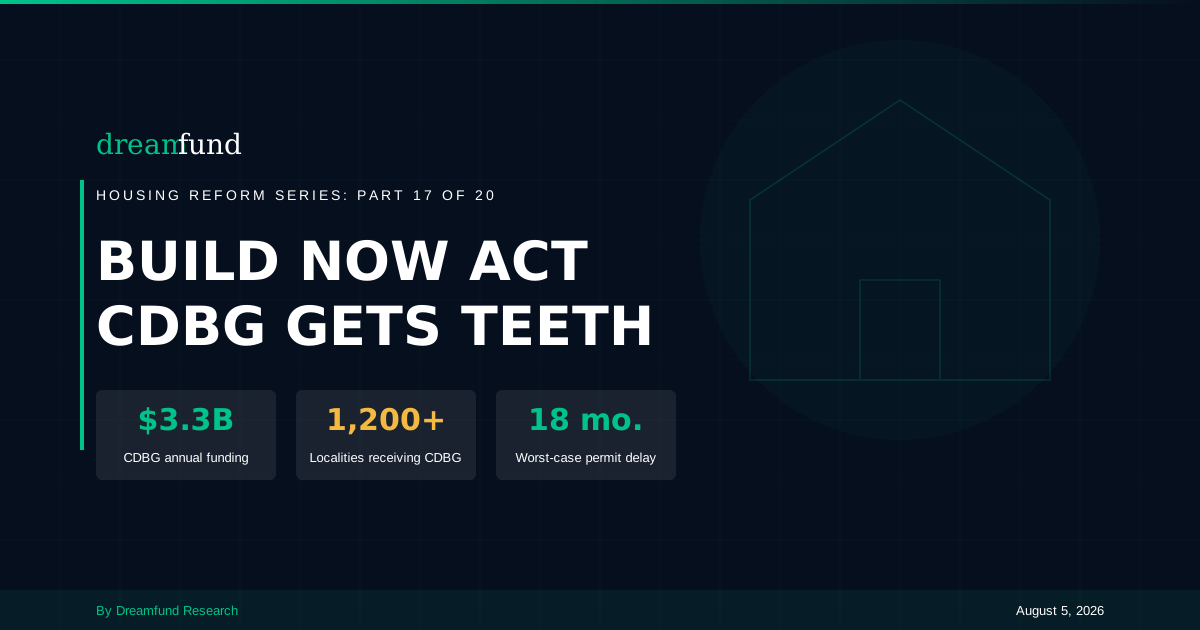
HOUSING REFORM SERIES: PART 17 OF 20 | 21st Century ROAD to Housing Act Deep Dive
For decades, local governments could restrict housing construction with no federal financial consequences. The Build Now Act changes that calculation by tying $3.3 billion in annual Community Development Block Grant funding to measurable housing supply performance.
Housing affordability in America is fundamentally a supply problem. For every major metropolitan area where workers cannot afford to live near their jobs, there is a local government that has consistently chosen restriction over construction. Zoning rules, environmental reviews, community opposition processes, and permitting delays have collectively kept housing supply far below the level needed to meet demand.
The federal government has historically lacked leverage to change this. Local zoning is a state and municipal prerogative. Washington could plead and publish reports, but it could not compel a suburb to approve apartments near a transit stop or a city council to streamline a 300-day permitting process.
The Build Now Act provisions of the 21st Century ROAD to Housing Act change this dynamic in a meaningful way. By tying Community Development Block Grant funding allocations to measurable housing supply performance, Congress has created the first significant federal financial incentive structure for local governments to actually build.
What CDBG Actually Funds
Before understanding how the Build Now Act changes things, it helps to understand what CDBG money actually pays for in communities across America. The Community Development Block Grant program has existed since 1974. It distributes roughly $3.3 billion annually to more than 1,200 cities, counties, and states through a formula that accounts for population, poverty levels, and housing overcrowding.
CDBG funds a wide range of community development activities: affordable housing rehabilitation, infrastructure improvements in low-income neighborhoods, economic development programs, public services for vulnerable populations, and blight elimination. For many smaller cities and rural communities, CDBG is a primary federal funding source for the kind of neighborhood investments that attract private development.
This gives the federal government significant leverage. CDBG money matters to local governments. Threatening to reduce or redirect it gets attention in ways that policy reports and congressional hearings do not.
The Performance Metrics Framework
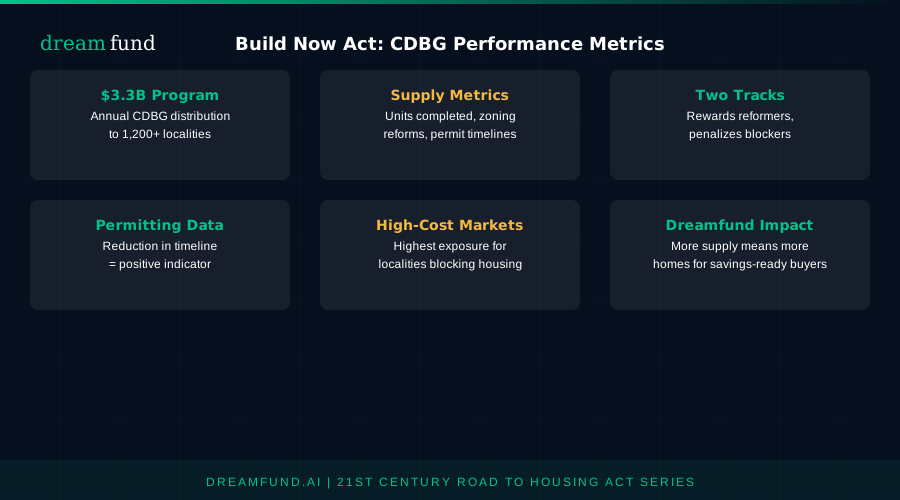
The Build Now Act directs the Department of Housing and Urban Development to establish a housing supply performance metrics framework and incorporate those metrics into the CDBG allocation formula. The framework tracks:
- Residential permit issuance rates relative to population growth and housing need estimates
- Permitting timeline reductions measuring whether localities are cutting the time from application to permit approval
- Zoning reform adoption tracking whether localities are adopting by-right zoning, reducing parking minimums, allowing accessory dwelling units, or taking other supply-enabling actions
- New unit completions as a final outcome measure
Localities are assessed annually. Those that show meaningful improvement on the metrics receive favorable treatment in the allocation formula, effectively getting bonus credit. Localities that show sustained restriction or decline face reduced allocations.
For the first time, a local planning department's decision to delay a permit or block an upzoning has a direct dollar cost attached to it at the federal level. That changes the internal political math in city halls across the country.
The Two-Track System
The Build Now Act creates a two-track system that operates simultaneously. Track one rewards reformers. Localities that adopt pro-supply policies, streamline permitting, and demonstrate real unit completions gain access to enhanced CDBG allocations and bonus eligibility for supplemental housing production grants. They become preferred partners for HUD technical assistance programs and get favorable consideration in competitive housing grants.
Track two penalizes blockers. Localities in high-cost markets with demonstrated housing need that persistently restrict supply face graduated reductions in their CDBG entitlement allocations. After two consecutive years of poor performance, they are required to submit a corrective action plan to HUD before their next allocation cycle. After three years, a portion of their CDBG allocation can be redirected to a regional housing authority or state housing finance agency to fund production in their market.
This two-track approach is deliberately designed to avoid the political backlash that a pure penalty system would generate. Localities can choose the positive incentive path. But the penalty path exists and is clearly defined, which gives the incentive path real teeth.
High-Cost Markets Are the Primary Target
The performance metrics are calibrated differently for different market types. Localities in high-cost markets, defined as areas where median housing costs exceed 30 percent of median household income, face more rigorous standards and higher exposure under the penalty track. This is intentional.
The housing crisis is most acute in exactly the places that have the most CDBG funding at stake: major coastal metros, their surrounding suburbs, and fast-growing sunbelt cities. San Jose, Seattle, Denver, Austin, Boston, and New York are not just the cities with the worst affordability problems. They are the cities with the most CDBG money flowing through their planning departments and community development offices.
Aligning financial consequences with the places of highest affordability crisis is the Build Now Act's central structural insight. It does not try to solve a problem in Topeka that does not exist. It puts pressure precisely where the housing gap is widest and the federal funding exposure is greatest.
What This Means for Buyers
If you are a buyer in a high-cost market who has been competing for an extremely limited supply of homes, the Build Now Act represents the most direct federal intervention on your behalf since the creation of the 30-year fixed mortgage.
The mechanism is indirect. The federal government is not building homes. It is changing the financial incentive structure for the local governments that control whether homes get built. But the mechanism does not need to be direct to be effective. Supply-side constraints are political problems. Political problems respond to political and financial incentives. The Build Now Act creates those incentives at a scale that will register in budget negotiations across hundreds of city halls.
More housing supply means more options. More options means reduced bidding war pressure. Reduced bidding war pressure means that a buyer who has been patiently saving through Dreamfund has a real shot at the home they have been targeting rather than being perpetually outbid by buyers with larger down payments or all-cash offers.
The demand side matters too. Dreamfund exists to help buyers save the down payment they need to be competitive. But savings without supply is just frustration. The Build Now Act addresses the supply side directly, making the combination of a funded buyer and an available home more likely than at any point in the last decade.
Frequently Asked Questions
What is the Build Now Act?
The Build Now Act is a provision within the 21st Century ROAD to Housing Act that ties Community Development Block Grant (CDBG) funding allocations to local housing supply performance metrics. Localities that demonstrate progress on permitting, zoning reform, and new unit construction receive favorable funding treatment. Localities that restrict housing supply face reduced allocations.
How much CDBG funding is affected by the Build Now Act?
The Community Development Block Grant program distributes approximately $3.3 billion annually to more than 1,200 localities across the United States. The Build Now Act makes housing supply performance a factor in how those allocations are calculated.
What metrics does the Build Now Act use to measure housing supply performance?
The Build Now Act directs HUD to establish metrics including residential permit issuance rates, permitting timeline reductions, zoning reform adoption, and new housing unit completions relative to local population and income growth.
How does the Build Now Act help first-time homebuyers?
By creating financial incentives for local governments to approve more housing construction, the Build Now Act addresses the supply side of the affordability crisis. More housing supply puts downward pressure on home prices in high-cost markets, improving affordability for buyers who have been priced out of their target communities.
Save while the supply picture improves.
More homes are coming to market. Dreamfund helps you build the down payment to be ready when your home appears.
Join the waitlistDisclaimer: This article is for informational purposes only and does not constitute financial, legal, or investment advice. Legislative summaries are based on publicly available bill text and may not reflect implementing regulations or agency guidance issued after publication. Consult qualified legal and financial professionals for advice specific to your situation.
Dreamfund is not a bank and does not hold customer funds. Upon launch, each customer's savings will be held in a deposit account opened in the customer's own name at an FDIC-member institution. FDIC deposit insurance applies to deposits at the member bank subject to applicable limits. Dreamfund itself is not FDIC-insured and does not guarantee any savings outcome.