Nine Provisions. One Community Bank Opportunity: Title IX of the ROAD Act
HOUSING REFORM SERIES: PART 18 OF 20 | 21st Century ROAD to Housing Act Deep Dive
Community banks and credit unions are the primary mortgage originators in hundreds of markets across America where large national banks have pulled back. Title IX gives those institutions nine separate regulatory relief provisions to keep them lending.
When people talk about mortgage access, the conversation usually centers on the borrower. Credit scores, debt-to-income ratios, down payment requirements. But there is a supply side to mortgage access that gets far less attention: whether the lenders who serve your community can afford to originate your loan in the first place.
Over the past fifteen years, the regulatory burden on mortgage origination has grown substantially. Most of those rules were designed with large national banks in mind, and most of the compliance infrastructure required to meet them is built into the systems of institutions that process thousands of loans per month. For a community bank in rural Iowa that closes 40 mortgages a year, or a credit union in South Carolina serving a mid-size city, those same rules carry a disproportionately heavy per-loan cost.
The practical result has been a slow but steady retreat of community financial institutions from residential mortgage lending. That retreat has hit hardest in exactly the markets where community banks and credit unions were the primary origination channel: small cities, rural communities, and urban neighborhoods where national bank branches have become scarce.
Title IX of the 21st Century ROAD to Housing Act addresses this directly with nine separate provisions targeted at institutions under $10 billion in assets.
The Nine Provisions at a Glance
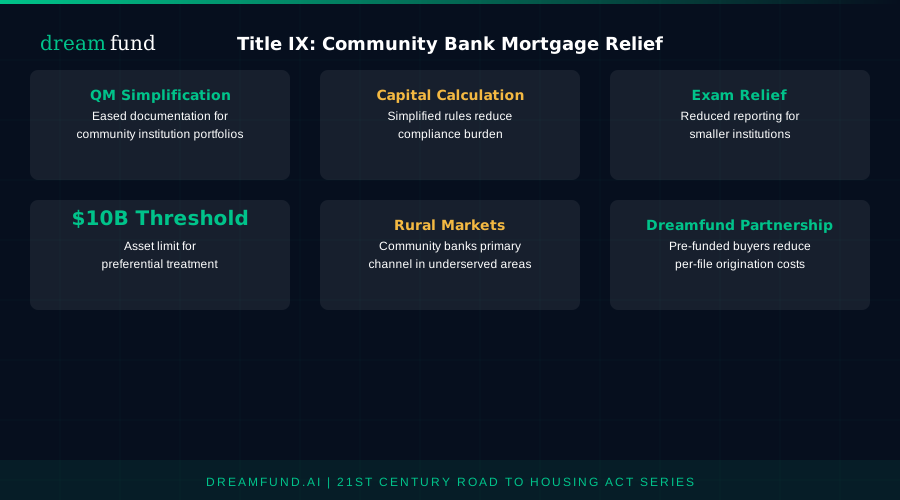
Title IX does not make a single sweeping change. It makes nine targeted adjustments, each addressing a specific friction point that has made community institution mortgage lending less economically viable. Together they form a comprehensive package of operational relief.
1. Qualified Mortgage Simplification for Portfolio Lenders
Community banks that hold mortgages in their own portfolio rather than selling them to the secondary market gain simplified QM documentation requirements. Since portfolio lenders are retaining the credit risk themselves, the rationale for the full GSE-aligned documentation burden has always been weaker. This provision aligns the regulatory requirement with the actual risk structure.
2. Capital Calculation Simplification
The provision simplifies the capital calculation methodology for mortgage assets held by community institutions. Smaller banks have historically been required to use the same complex risk-weighting frameworks as the largest national banks, creating disproportionate compliance cost. The simplified methodology reduces that burden while maintaining appropriate capital adequacy standards.
3. Examination Reporting Relief
Community banks and credit unions below the asset threshold gain reduced mortgage examination reporting requirements. This does not reduce examination frequency or substantive oversight. It reduces the administrative preparation burden for routine examinations, freeing up compliance staff capacity for actual risk management rather than report generation.
4. Small Creditor Exemptions
The definition of "small creditor" under several CFPB rules is updated to reflect current market conditions. Institutions qualifying as small creditors gain access to simplified compliance pathways for balloon-payment mortgages, certain refinancing restrictions, and escrow requirements that had previously created friction in rural and underserved market lending.
5 through 9. Additional Technical Relief
The remaining five provisions address specific technical areas including HMDA reporting thresholds, appraisal requirements for rural properties, flood insurance escrow requirements for portfolio lenders, BSA/AML examination procedures for lower-risk community institutions, and the definition of higher-priced mortgage loans in low-cost markets where the rate benchmarks were designed for different cost environments.
Each provision individually is a technical adjustment. Together they represent a meaningful reduction in the per-loan compliance cost for community lenders, which directly translates into a lower threshold for originating loans that were previously marginal from a business perspective.
Why Community Banks Matter for First-Time Buyers
National banks follow a logic of scale efficiency. They build systems and products designed to originate large volumes of standardized loans. A first-time buyer with a non-standard employment history, a recently improved credit profile, a thin credit file, or a property in a lower-cost market does not fit cleanly into the national bank origination pipeline.
Community banks and credit unions have historically been willing to underwrite these borrowers because their loan officers know the community. They can evaluate a borrower's story in context. A two-year employment gap for a nurse who took time to care for a parent is different from a two-year gap for other reasons, and a local lender who knows that nurse's employer and community standing can make that judgment. A national bank's automated underwriting engine cannot.
Title IX makes it more economically viable for community institutions to continue serving these borrowers. That directly expands mortgage access for exactly the buyers who have the hardest time finding a lender willing to approve their application.
The Dreamfund Connection
Dreamfund's platform is designed to work alongside community lenders, not to replace them. A buyer who has accumulated a documented down payment through Dreamfund, with a full gift documentation package and a verified savings trail, arrives at any lender's desk as a significantly stronger applicant than an equivalent buyer with no documentation infrastructure behind them.
For community banks with limited per-loan compliance capacity, a pre-documented borrower is not just a better credit risk. It is a lower operational cost per origination. The file arrives more complete. The underwriting questions are more easily answered. The closing timeline compresses.
This creates a natural partnership opportunity. Community lenders who want to expand their first-time buyer origination pipeline benefit from working with buyers who have been building financial readiness through a structured platform. The Title IX relief provisions make the economics of those originations more favorable. Dreamfund's documentation infrastructure makes the files more efficient to process. The combination serves buyers in exactly the markets where they have historically had the least access.
Frequently Asked Questions
What does Title IX of the ROAD Act do for community banks?
Title IX contains nine deregulation provisions for community banks and credit unions with assets under $10 billion. These provisions ease qualified mortgage documentation requirements for portfolio loans, simplify capital calculation rules, reduce examination reporting burdens, and provide other compliance relief that makes mortgage origination more economically viable for smaller institutions.
What is the $10 billion asset threshold in Title IX?
The $10 billion asset threshold is the ceiling below which a financial institution qualifies for the preferential regulatory treatment offered by Title IX. There are approximately 4,500 institutions that qualify nationwide.
How does Title IX help first-time homebuyers?
Community banks and credit unions are often the primary mortgage originators in rural areas and historically underserved neighborhoods. By reducing the compliance cost of originating portfolio mortgages, Title IX makes it more economically viable for these institutions to continue lending to first-time buyers in their communities.
What is QM simplification for community banks?
QM simplification refers to a provision in Title IX that eases documentation and underwriting requirements for mortgages that community banks hold in their own portfolio rather than sell to the secondary market. Portfolio lenders retain the credit risk themselves, which justifies a reduced regulatory compliance burden relative to secondary market lending.
Build the down payment that opens every door.
Dreamfund works alongside community lenders to help first-time buyers arrive pre-documented, pre-funded, and ready to close.
Join the waitlistDisclaimer: This article is for informational purposes only and does not constitute financial, legal, or investment advice. Legislative summaries are based on publicly available bill text and may not reflect implementing regulations or agency guidance issued after publication. Consult qualified legal and financial professionals for advice specific to your situation.
Dreamfund is not a bank and does not hold customer funds. Upon launch, each customer's savings will be held in a deposit account opened in the customer's own name at an FDIC-member institution. FDIC deposit insurance applies to deposits at the member bank subject to applicable limits. Dreamfund itself is not FDIC-insured and does not guarantee any savings outcome.